Gottlieb Law, PLC provides this article for information purposes only and nothing herein creates an attorney-client relationship. You should not take any actions in reliance on any of the information contained herein without consulting with qualified legal counsel first and reading this article is not a proper substitute for seeking legal advice of your specific situation. Laws change over time and you should seek counsel to discuss any specific legal questions.
SB 1641 Explained — Why It Failed, Why It Matters, and What Arizona May See Next
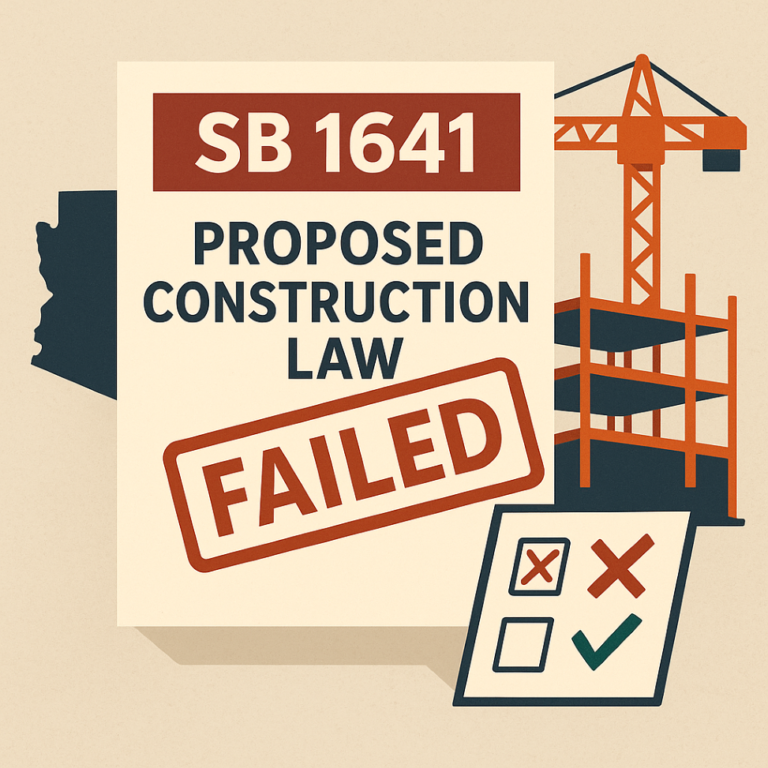
Arizona’s construction-defect laws remain unchanged for now—but SB 1641 shows where reform efforts are headed. SB 1641, which is Arizona’s high-profile proposal to overhaul construction-defect deadlines and add a two-thirds owner-approval requirement for condo litigation, did not become law in 2025 and so Arizona construction law remains unchanged as of the date of this blog. But while the bill stalled, the ideas behind it are not going away.
The legislation reflected growing pressure from builders, insurers, and developers to shorten claim windows and restrict defect lawsuits. At the same time, HOAs, consumer advocates, and homeowners fought back, arguing that shorter deadlines would leave buyers unprotected and encourage rushed construction.
Although SB 1641 failed, it reveals a clear direction of future legislative attempts. For anyone building, buying, developing, or managing property in Arizona, understanding why this bill surfaced—and why it may return is essential.
What SB 1641 Would Have Changed (and Why It Created So Much Debate)
Although SB 1641 ultimately did not pass in 2025, the bill proposed some of the most significant construction-defect reforms Arizona has seen in years. Understanding these proposed changes matters because many are likely to reappear in future sessions.
Here’s what the bill sought to do:
SB 1641 proposed shortening the period to bring construction-related contract claims—from eight years down to four years after “substantial completion.”
1) SB 1641 Proposed Cutting Arizona’s Statute of Repose in Half (It Did Not Pass)
Supporters argued this would:
- give builders earlier certainty
- reduce insurance costs
- encourage faster dispute resolution
Opponents countered that:
- many defects are not visible for five to eight years
- reducing the window could leave homeowners without recourse
- Arizona’s rapid-build environment increases the risk of latent defects
The eight-year repose period in A.R.S. § 12-552 remains intact today as of the date of this blog.
2) Create a Strict Two-Year Latent-Defect Extension (Capped at Six Years)
Under existing law, latent defects found in the eighth year may be brought within one additional year (up to nine years).
SB 1641 would have replaced this with:
- a discovery extension only if the defect is found in Year 4
- an absolute six-year maximum from substantial completion
This proposal followed a trend toward shorter tail exposure for builders — something insurers strongly support.
Since the bill failed, the current eight-plus-one framework remains Arizona law.
3) Require a Two-Thirds Owner Vote for Condo and HOA Litigation
One of the most controversial proposals was a requirement that condo associations obtain:
Approval from two-thirds of all unit owners before filing a construction-defect lawsuit.
Builders argued this would:
- prevent board-initiated lawsuits that not all owners support
- bring transparency to large litigation decisions
HOAs argued it would:
- make it nearly impossible to bring legitimate claims
- allow a minority of investors or absentee owners to block needed repairs
- shift repair costs onto homeowners instead of builders
This provision also did not become law, but similar proposals have appeared in multiple states.
4) Apply These Rules Broadly Across Public and Private Projects
SB 1641 attempted to apply its timing rules to:
- residential and commercial projects
- public works
- design professionals
- implied warranty claims
This broad scope shows how far-reaching the reform effort was intended to be. Because the bill failed, no such expansion occurred.
Who Would Have Been Affected — and Why It Still Matters
Even though SB 1641 did not pass, every stakeholder group paid close attention to its proposals:
Homeowners & Condominium Associations
They opposed the bill because:
- shorter deadlines reduce time to inspect and discover defects
- condo voting requirements can stall or block valid claims
- latent defects (water intrusion, foundation movement) often show up late
This fight is not over—future bills may try again.
Builders, Contractors & Design Professionals
They supported the bill because:
- shorter deadlines reduce long-term exposure
- litigation costs decrease
- insurance premiums may drop
- substantial completion dates become more important
Even without SB 1641, builders may respond by tightening contractual notice provisions and recordkeeping, anticipating new legislation.
Municipalities and Public Entities
The bill would have applied to government defect claims as well, reflecting a trend toward uniformity across project types.
Public entities generally took no formal position, but insurers and public-works contractors supported the change.
Developers, Lenders & Insurers
These groups paid particular attention because shorter exposure windows affect:
- project risk profiles
- lending criteria
- wrap insurance
- owner-builder warranty practices
Even without new law, the industry may begin behaving as though reforms are coming.
Contracts, Warranties, and Risk Transfer: What SB 1641 Signals for the Future
Even though SB 1641 did not become law, the bill is a clear warning that Arizona may see efforts to shorten construction-defect timelines and tighten procedural requirements in future legislative sessions.
For property owners, contractors, and developers, this is the right time to review contracts and risk-allocation documents to ensure they are ready if similar reforms return.
Here are forward-looking steps parties may want to consider with legal counsel:
• Define “substantial completion” clearly in contracts
Future reforms—like those proposed in SB 1641—tend to make the completion date the anchor for all limitations and notice deadlines. Clear documentation protects everyone involved.
• Revisit notice and warranty provisions
Even under current law, parties can contractually require earlier notice of potential defects. Builders, designers, and owners may all seek greater clarity in future agreements.
• Evaluate contractual limitation-of-action clauses
While statutes of repose cannot be extended, some contractual limitation periods may be shortened (if enforceable). SB 1641’s proposals highlight a trend toward earlier claim deadlines.
• Coordinate insurance and indemnity language
If future reforms shorten exposure periods, insurance requirements and subcontractor indemnity provisions will need to reflect those compressed timelines.
Gottlieb Law assists clients in reviewing and updating construction contracts to ensure they remain protective under both current law and anticipated reforms.
For Property Owners: A Quick Preservation Checklist
Even under existing law, homeowners and associations should take proactive steps after a project reaches substantial completion. These steps become even more important if Arizona revisits reforms similar to SB 1641.
• Confirm the substantial completion date
Collect final inspection reports, occupancy certificates, and contractor correspondence.
• Schedule early inspections
Professional evaluations soon after completion help identify issues before they worsen.
• Provide written notice promptly
Under the current Notice and Opportunity to Repair statutes (A.R.S. § 12-1361 et seq.), timely notice preserves rights.
• Preserve communications and records
Photos, invoices, emails, and bids are critical evidence.
For Condo Boards: Review Voting and Governance Procedures
Even though SB 1641’s two-thirds vote requirement did NOT pass, HOAs should still understand their internal processes in case similar legislation returns.
Gottlieb Law supports homeowners and associations in documenting completion, preserving evidence, and navigating the statutory pre-litigation requirements.
For Contractors and Design Professionals: Keep Records Tight
Regardless of legislation, the construction industry faces increasing pressure to prove:
- exact completion dates
- what work was performed
- how work was inspected
- which subcontractors were responsible
If Arizona revisits reforms like SB 1641, strong documentation will be essential.
Recommended practices include:
- maintaining comprehensive close-out files
- retaining as-builts, test results, punch lists, and change orders
- documenting substantial completion with signed certifications
- aligning insurance and bonding requirements with contractual timelines
Gottlieb Law advises contractors and engineers on updating templates and policies to prepare for potential future reforms.
How Litigation Strategy Could Shift if Similar Proposed Limits Return
Should Arizona revive proposals like SB 1641, litigation strategy could shift immediately:
- plaintiffs may need to act faster to investigate and file claims
- defendants may raise timing defenses earlier
- “substantial completion” will become a central factual dispute
- expert involvement will likely occur earlier in a claim’s life cycle
Even under current law, establishing substantial completion remains a critical element in most construction-defect disputes.
What Gottlieb Law Is Doing for Construction Projects
While SB 1641 did not become law, the policy push behind it is unlikely to disappear. Gottlieb Law helps:
- owners and associations preserve claims under current statutes
- contractors and developers strengthen documentation and risk-transfer provisions
- boards understand governance and voting obligations before litigation
- parties evaluate exposure for projects completed within the past eight years
- clients adapt their contracts and procedures in anticipation of possible future reforms
Call Gottlieb Law today at 602-899-8188 or use our Contact Us page here to schedule your initial consultation.
Gottlieb Law, PLC provides this article for information purposes only and nothing herein creates an attorney-client relationship. You should not take any actions in reliance on any of the information contained herein without consulting with qualified legal counsel first and reading this article is not a proper substitute for seeking legal advice of your specific situation. Laws change over time and you should seek counsel to discuss any specific legal questions.