Gottlieb Law, PLC provides this article for information purposes only, and nothing herein creates an attorney-client relationship. You should not take any actions in reliance on any of the information contained herein without consulting with qualified legal counsel first, and reading this article is not a proper substitute for seeking legal advice for your specific situation. Laws change over time, and you should seek counsel to discuss any specific legal questions.
Current Arizona Short-Term Rental Law
Arizona remains one of the more short-term-rental-friendly states in the country — but not without regulation.
Under A.R.S. § 9-500.39 (cities and towns) and A.R.S. § 11-269.17 (counties):
- Municipalities may not prohibit vacation rentals or short-term rentals.
- Local governments may not regulate STRs differently solely based on classification, use, or occupancy — except as specifically authorized by statute.
- State preemption remains in effect.
However, cities and counties may regulate STRs for certain purposes, including:
- Public health and safety (fire, building, sanitation, traffic, waste).
- Nuisance enforcement (noise, property maintenance, welfare protections).
- Local permit or licensing requirements (fee capped at actual cost or $250).
- Emergency contact designation requirements.
- Mandatory liability insurance (minimum $500,000 coverage).
- Structured civil penalties for verified violations.
- Suspension of local permits for qualifying violations.
- Prohibition of nonresidential event-style uses (e.g., weddings, banquet halls, retail operations).
Short-term rentals remain legal statewide, but enforcement authority is significantly stronger than in the early years following preemption.
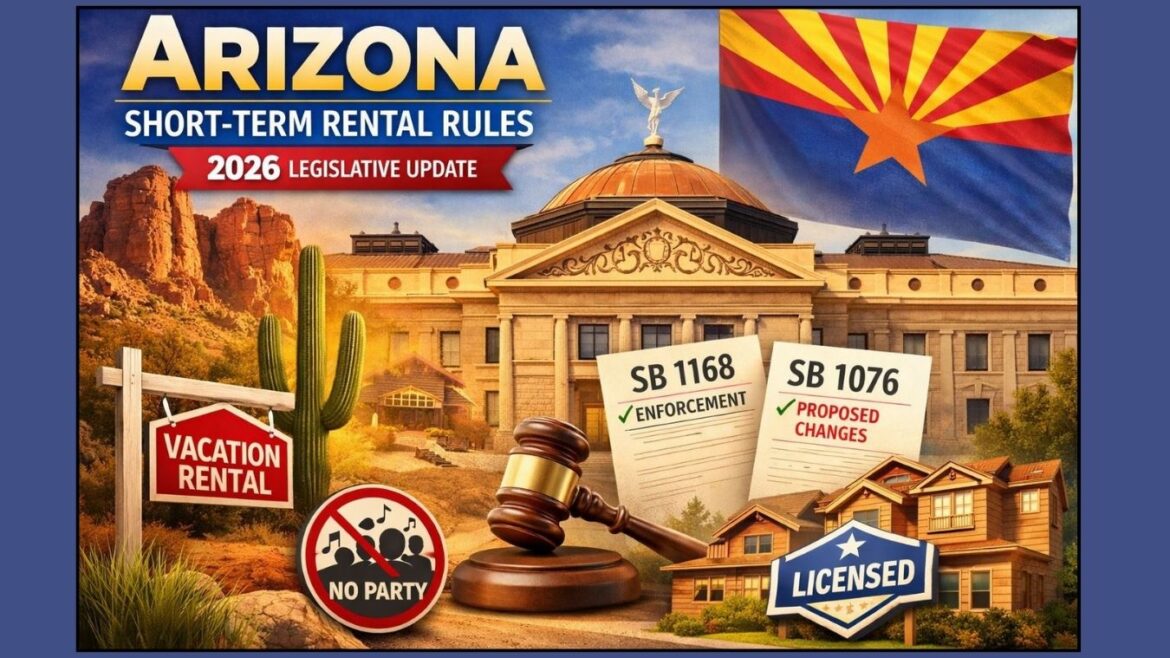
The 2022 Turning Point: SB1168 (Laws 2022, Ch. 343)
The most significant modern shift in Arizona STR regulation occurred in 2022 with Senate Bill 1168.
That legislation did not repeal state preemption. Instead, it strengthened enforcement and regulatory structure by:
- Authorizing local permit requirements (with capped fees).
- Establishing a graduated civil penalty schedule.
- Allowing permit suspension for repeated verified violations.
- Requiring emergency contact availability.
- Prohibiting nonresidential event-style uses.
- Strengthening transaction privilege tax (TPT) enforcement and advertising requirements.
After 2022, Arizona shifted from a largely hands-off preemption model to a structured enforcement framework.
STRs remained legal — but municipalities gained clearer authority to discipline bad actors.
For more background on Arizona’s evolving STR laws, check out our earlier coverage:
- Guide to Arizona Short-Term Rental Laws in 2024
- Legal Tips for Short-Term Rental Properties in Arizona
Proposed 2026 Legislation: SB1076
As of this writing (February 2026), SB1076 has been introduced but has not yet been enacted into law. Viewers should consult with a lawyer to confirm if the law has been passed at a later date.
If passed in its current form, SB1076 would amend A.R.S. § 9-500.39 to allow:
- Cities and towns with a population under 70,000 to:
- Set a maximum number of STR permits.
- Impose minimum distance requirements between STR properties.
- Set a maximum number of STR permits.
Importantly:
- Larger cities such as Phoenix, Scottsdale, Mesa, and Tempe would not receive this authority.
- The bill does not authorize outright bans.
- State preemption would remain intact.
- The legislation is currently pending and subject to amendment or failure.
Because SB1076 has not passed as of February 2026, property owners should not assume these changes are currently in effect but should monitor updates accordingly as time passes.
Other Proposed 2026 STR Bills
Multiple additional bills referencing § 9-500.39 have been introduced during the 2026 session. These proposals address topics such as regulatory notice requirements and scope of authority.
As of now:
- None have been enacted as of February 2026.
- All remain subject to committee review and amendment.
- The final legislative outcome remains uncertain.
STR operators should monitor legislative developments closely.
What Cities and Counties Can Regulate Right Now
Under current law, local governments may regulate:
- Health and safety compliance.
- Noise and nuisance issues (applied equally to comparable residential property).
- Permit or registration requirements.
- Emergency contact availability.
- Liability insurance requirements.
- Civil penalties for verified violations.
- Nonresidential event uses.
They may not:
- Prohibit STRs outright.
- Impose zoning bans targeted specifically at STRs inconsistent with state preemption.
- Enact density caps or spacing requirements (unless future legislation authorizes it).
Zoning Considerations
Municipal zoning authority remains subject to statutory limits.
Any zoning regulation affecting STRs must be applied in the same manner as other similarly classified residential property under Title 42.
At present, municipalities cannot impose targeted density caps or spacing requirements unless new legislation is enacted.
HOA and Private Community Restrictions
Even where municipal regulation permits STR operation, homeowners’ associations may restrict or prohibit short-term rentals through CC&Rs.
HOA authority operates independently of municipal regulation.
STR owners should review governing documents carefully before operating.
Enforcement and Penalties
Current statute authorizes:
- Civil fines beginning at $500 (or one night’s rent, whichever is greater).
- Escalating fines for repeat violations.
- Suspension of local permits for up to 12 months after qualifying violations.
- Mandatory cessation of operations for failure to obtain required permits.
Repeated violations can create substantial financial and operational risk.
Recent Case Law Update
In late 2025, the Arizona Court of Appeals reinforced the application of state preemption in Oak Creek Hospitality, LLC v. City of Sedona. The court held that the statutory phrase “house or dwelling unit” in A.R.S. § 9-500.39 includes individual mobile home units, meaning a city may not categorically prohibit short-term rentals simply because the dwellings are mobile homes located in a mobile home park. The decision also underscores that preemption issues can arise from how a city enforces its rules, not just how an ordinance is written. At the same time, the court recognized that cities may still require owners to follow the statute’s permitting and compliance process.
Practical Takeaways for STR Owners
- State preemption remains in place.
- Enforcement authority has expanded significantly since 2022.
- Density caps and spacing requirements are not currently authorized under existing law.
- SB1076 could change the landscape for smaller municipalities if enacted.
- Compliance with permit, insurance, and emergency contact requirements is essential.
- Legislative developments in 2026 warrant monitoring.
When to Seek Legal Guidance
Legal consultation may be appropriate when:
- Facing municipal enforcement action.
- Evaluating STR acquisition.
- Drafting rental agreements.
- Addressing HOA restrictions.
- Responding to citations or suspension proceedings.
- Planning investment strategy amid pending legislative change.
Arizona’s STR framework continues to evolve. Understanding both current law and proposed changes is essential for responsible ownership and investment.
How Gottlieb Law Can Help
Arizona’s short-term rental law is no longer one-size-fits-all. Gottlieb Law provides customized legal guidance for STR property owners, managers, and investors across the state.
We help our clients:
- Navigate short-term rental issues
- Draft contracts
- Understand local ordinances.
- Dispute HOA or city citations.
- Handle complaints or enforcement actions.
If you’re uncertain about your compliance or need help resolving an issue, schedule a consultation with our team today. Contact Gottlieb Law today at 602-899-8188 to schedule a consultation or visit gottlieblawaz.com.
Gottlieb Law, PLC provides this article for information purposes only, and nothing herein creates an attorney-client relationship. You should not take any actions in reliance on any of the information contained herein without consulting with qualified legal counsel first, and reading this article is not a proper substitute for seeking legal advice for your specific situation. Laws change over time, and you should seek counsel to discuss any specific legal questions.