
HOA Law

Arizona HOA liens can lead to foreclosure in certain cases. Learn the rules, thresholds, lien priorities, and options property owners should know.

HOA Liens And Foreclosure Rights In Arizona

HOA Liens And Foreclosure Rights In Arizona 852 567 Gottlieb Law

Gottlieb Law, PLC provides this article for information purposes only and nothing herein creates an attorney-client relationship. You should not take any actions in reliance on any of the information contained herein without consulting with qualified legal counsel first and reading this article is not a proper substitute for seeking legal advice of your specific situation.  Laws change over time and you should seek counsel to discuss any specific legal questions.

An unpaid homeowners association balance can become much more serious than a collection letter. Arizona law gives HOAs and condominium associations lien rights that may eventually support foreclosure, but strict requirements must be met before an owner’s property can be sold.

Those rules aren’t identical for every type of community. The statutory framework differs in some respects depending on whether the property is part of a planned community or condominium, and the type of charge appearing on an association ledger can also affect the association’s legal remedies. Property owners facing an escalating balance should understand those distinctions before assuming every association debt carries the same risk.

How HOA Liens Work In Arizona

Arizona law generally gives condominium and planned community associations a common expense lien for assessments levied against a unit or property from the time the assessment becomes due.  See A.R.S. §§ 33-1256(A), 33-1807(A).  That lien attaches to the property and can create complications during a sale, a refinance, a title review, or an ownership dispute.

An association account can include several charges, such as assessments, late charges, collection expenses, attorney fees, fines, and other owner-specific costs. Those amounts shouldn’t automatically be treated as legally identical.

  • Regular assessments can carry significant statutory lien rights.
  • Fines and certain owner-specific charges may be subject to different collection rules.
  • The association’s governing documents can also affect how assessments and charges are imposed.

A careful review of the ledger is often one of the first steps in evaluating a dispute.

When Can A Planned Community HOA Foreclose?

Arizona law places meaningful limits on foreclosure involving planned community associations. Under A.R.S. § 33-1807, a planned community association may generally foreclose its common expense lien if the owner has been and remains delinquent in the payment of an assessment or portion of an assessment for at least 18 months or in the amount of $10,000 or more, whichever occurs first, as determined on the date the foreclosure action is filed. For a special assessment with an initial value of $10,000 or more, however, only the 18-month delinquency threshold applies. 

The association must also make reasonable efforts to communicate with the homeowner and offer a reasonable payment plan before filing a foreclosure action. 

Condominium Associations Are Governed By A Separate Statute 

Condominium associations are governed by A.R.S. § 33-1256. Under current Arizona law, a condominium association may generally foreclose its common expense lien if the unit owner has been and remains delinquent in the payment of an assessment or portion of an assessment for at least 18 months or in the amount of $10,000 or more, whichever occurs first, as determined on the date the foreclosure action is filed.

For a special assessment with an initial value of $10,000 or more, only the 18-month delinquency threshold applies.

As with planned communities, a condominium association’s board must make reasonable efforts to communicate with the owner and offer a reasonable payment plan before filing a foreclosure action.

An HOA Foreclosure Is A Court Process

Arizona HOA foreclosure generally requires a judicial foreclosure action. The association files a lawsuit and must establish its right to enforce the lien before the property can be sold.

The process may involve:

  • Filing a foreclosure complaint in Superior Court.
  • Giving the homeowner an opportunity to respond.
  • Determining the valid assessment balance and lien rights.
  • Obtaining a foreclosure judgment.
  • Proceeding toward a sheriff’s sale if the dispute isn’t resolved.

Waiting until a judgment has been entered can greatly reduce the owner’s practical options.

What Happens If The Property Has A Mortgage?

A mortgage or deed of trust doesn’t necessarily prevent an HOA from foreclosing. Arizona law generally gives a recorded first mortgage or first deed of trust priority over the association’s common expense lien. 

As a result, foreclosure of a junior HOA lien generally does not extinguish that senior lien. A purchaser at an HOA foreclosure sale may therefore acquire title subject to the senior mortgage or deed-of-trust lien.

Junior liens can raise different issues. Lien priority should be reviewed carefully before anyone assumes which interests will survive a foreclosure sale.

What Property Owners Should Review

An HOA demand should be evaluated based on more than just the total balance printed at the bottom of the statement. Owners should gather the underlying documents and determine exactly how the amount was calculated.

Important records may include:

  • The complete HOA account ledger.
  • The declaration, CC&Rs, and collection policy.
  • Assessment notices and certified-mail records.
  • Payment history and payment-plan correspondence.
  • Recorded lien documents.
  • Mortgage and title information.

Errors involving payment application, fees, notices, or assessment classifications can materially affect a foreclosure dispute.

Addressing The Problem Before Foreclosure

Many HOA disputes are easier to resolve before litigation develops. Depending on the circumstances, an owner may be able to bring assessments current, negotiate a payment plan, challenge improper charges, request an updated payoff, or reach a settlement.

Early review can also determine whether the association has satisfied Arizona’s foreclosure requirements. Once legal fees accumulate and court deadlines begin running, the cost and complexity of the dispute can increase quickly.

Contact An Arizona Real Estate Attorney

HOA lien disputes can involve assessment calculations, statutory deadlines, foreclosure procedures, lien priority, title issues, and governing documents all at once. A relatively small account dispute can become a serious property-rights problem if it isn’t addressed early.

Gottlieb Law represents clients throughout Arizona in real estate disputes involving liens, ownership interests, title issues, and foreclosure-related matters. If an HOA lien is affecting your property or you’ve received notice of a foreclosure action, contact Gottlieb Law at 602-899-8188 to discuss your options.

Frequently Asked Questions About HOA Liens And Foreclosure Rights In Arizona

Can An HOA Foreclose On A Home In Arizona?

Yes. Arizona law allows qualifying HOA assessment liens to be foreclosed under specific circumstances. The association must satisfy the applicable statutory requirements before proceeding.

When Can A Planned Community HOA Foreclose? 

A planned community may generally pursue foreclosure after qualifying assessment debt reaches $10,000 or remains delinquent for 18 months, whichever occurs first. For a special assessment with an initial value of $10,000 or more, however, only the 18-month delinquency threshold applies. Other statutory conditions must also be satisfied.

Are Condominium Rules Different?

Condominium associations are governed by a separate statute, A.R.S. § 33-1256, but under current Arizona law the general foreclosure threshold is also 18 months of delinquency or $10,000 in qualifying assessment debt, whichever occurs first. Special assessments with an initial value of $10,000 or more are subject to the 18-month delinquency threshold. Other statutory requirements also apply.

Does A Mortgage Stop HOA Foreclosure?

Not necessarily. An HOA may still foreclose even if a mortgage or deed of trust exists. A recorded first mortgage or first deed of trust generally retains priority over the association’s lien. 

Do HOA Fines Count Toward Foreclosure?

Not every charge receives the same foreclosure treatment as common expense assessments. Fines and certain owner-specific expenses may be handled differently. The account ledger should be reviewed carefully.

Can An HOA Foreclose Immediately After A Missed Payment?

Generally, no. Arizona imposes statutory foreclosure thresholds and pre-foreclosure requirements. A single recent missed assessment doesn’t automatically create an immediate foreclosure right.

Can A Homeowner Negotiate A Payment Plan?

Often, yes. Arizona law requires reasonable efforts to communicate and offer a reasonable payment plan before qualifying foreclosure actions are filed. Acting early can preserve more options.

Can An HOA Assessment Lien Expire?

Yes. Arizona law places limits on how long an association may wait to enforce an assessment lien. The applicable rules can depend on the nature of the charges, when they became due, and whether enforcement proceedings have been commenced. Property owners and associations should evaluate the current statutes and the specific history of the account and consult with counsel before assuming a lien remains enforceable.


Gottlieb Law, PLC provides this article for information purposes only and nothing herein creates an attorney-client relationship. You should not take any actions in reliance on any of the information contained herein without consulting with qualified legal counsel first and reading this article is not a proper substitute for seeking legal advice of your specific situation.  Laws change over time and you should seek counsel to discuss any specific legal questions.


HOA Architectural Disputes in Arizona - Gottlieb Law

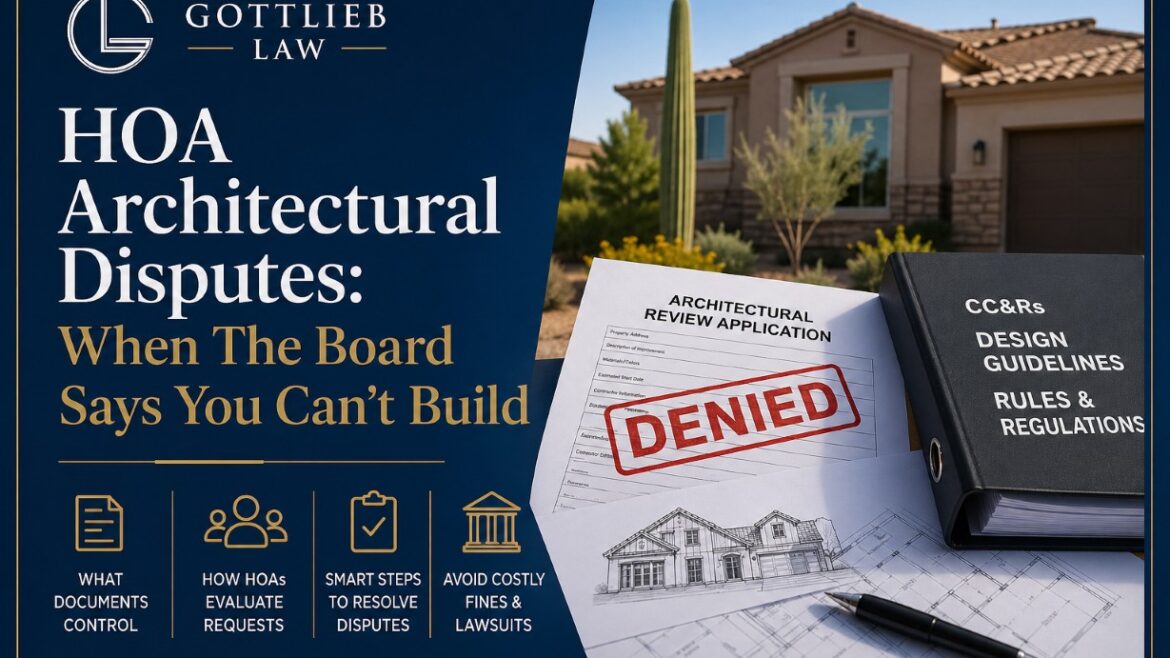
HOA Architectural Disputes: When The Board Says You Can’t Build

HOA Architectural Disputes: When The Board Says You Can’t Build 1229 819 Gottlieb Law

Gottlieb Law, PLC provides this article for information purposes only and nothing herein creates an attorney-client relationship. You should not take any actions in reliance on any of the information contained herein without consulting with qualified legal counsel first and reading this article is not a proper substitute for seeking legal advice of your specific situation.  Laws change over time and you should seek counsel to discuss any specific legal questions.


If you’ve ever submitted plans for a patio cover, addition, new fence, solar installation, or even a paint color and received a denial, you already know how frustrating HOA architectural rules can be. Most homeowners are not trying to create conflict. They are simply trying to improve their property, keep up with maintenance, or adapt their home to practical needs. At the same time, HOA boards are typically focused on maintaining a consistent community appearance and protecting property values, and they often view enforcement of architectural standards as part of that responsibility.

Architectural disputes frequently escalate because the stakes feel personal. A homeowner’s property is often their most significant investment, and a denial can delay a project, increase costs, and create ongoing tension with the association. In many cases, HOA boards are given discretion under the governing documents to approve or deny applications, and courts may defer to those decisions if they are made in good faith and within the scope of the association’s authority. At the same time, these disputes can often be addressed more effectively when approached with proper documentation, attention to deadlines, and a clear plan.


Why HOAs Deny Architectural Requests

HOAs typically justify denials using a few common themes. In some cases, the concerns are legitimate and can be addressed through revisions to the application. In other situations, a denial may feel arbitrary or inconsistent, or may come after work has already been completed—circumstances that often lead to disputes.

Boards may deny requests for reasons such as:

  • The proposed plans conflict with the community’s architectural or aesthetic guidelines.
  • The improvement would appear inconsistent with nearby homes, in the board’s view.
  • The application does not comply with the association’s stated approval procedures.
  • The board is concerned about setting a precedent for similar future requests.
  • The submission is incomplete, lacking necessary materials such as dimensions, colors, or contractor information.

Disputes can also arise when a homeowner seeks an accommodation related to accessibility or a disability, and the HOA evaluates the request solely as an aesthetic issue. These situations may implicate federal and state fair housing laws and require careful handling.

The Documents That Control The Outcome

Architectural disputes rarely turn on who is more persuasive. Instead, they typically depend on what the governing documents provide, what the architectural guidelines require, and whether the HOA followed its own procedures in a consistent and reasonable manner.

A strong starting point is gathering and reviewing:

  • The CC&Rs, bylaws, and any architectural rules or design guidelines.
  • The architectural review committee procedures, including deadlines and submission requirements.
  • Past approvals for similar projects, if available.
  • Your complete submission package, along with proof of delivery.
  • Written communications from the HOA, including the stated basis for the denial.

While boards often have discretion under the governing documents, that discretion is not unlimited. Disputes can arise where enforcement appears selective, inconsistent, or significantly delayed without a clear basis.

What To Do Immediately After A Denial

After a denial, the initial objective is to slow the process down and create a clear written record. Acting too quickly—especially by beginning construction or relying on informal conversations—can make the situation more difficult to resolve.

A practical sequence to consider includes:

  • Requesting the denial in writing if it was communicated verbally.
  • Asking the HOA to identify the specific provision of the governing documents or guidelines relied upon.
  • Confirming whether the decision is final or whether resubmission is permitted.
  • Asking what revisions, if any, would bring the application into compliance.
  • Preserving all communications, submissions, and supporting materials in an organized format.

If the denial lacks specificity, it is reasonable to request clarification. For example, if the HOA cites general “aesthetic concerns,” a homeowner may ask what objective standards apply. Architectural guidelines often address measurable or identifiable factors such as colors, materials, height, setbacks, and visibility from the street. The more specific the discussion becomes, the more likely it is that a practical resolution can be reached.

How HOAs Typically Handle Violations And Why That Matters

Some disputes begin with a denial. Others arise after work has already been completed, when the HOA asserts a violation of its architectural rules. In those situations, the enforcement process—and the consistency of that process—can become important.

In many communities, a typical enforcement approach includes identifying the alleged violation, providing notice to the homeowner, allowing an opportunity to respond or correct the issue, and escalating only if the matter is not resolved. The specific requirements, however, depend on the governing documents and applicable law.

That framework can also help homeowners evaluate how a situation is being handled. Questions to consider include:

  • Was the alleged violation reasonably verified, or is it based on assumptions?
  • Did the HOA provide a clear description of the issue and identify the applicable rule?
  • Was a reasonable timeline provided for correction or for submitting an application?
  • Did the HOA allow for the possibility of retroactive approval, where appropriate?

If the process appears unclear, rushed, or inconsistent with how similar situations have been handled, disputes are more likely to escalate.

Practical Paths To Resolution Before It Becomes A Lawsuit

In many cases, both homeowners and HOA boards share a similar goal: reaching a resolution that maintains compliance with the governing documents while avoiding unnecessary conflict. With that in mind, there is often room to resolve architectural disputes without litigation.

Potential options may include:

  • Resubmitting plans with revisions that address the specific concerns identified by the HOA.
  • Proposing alternative materials or colors that align with approved standards.
  • Adjusting placement, height, or visibility to better fit within the guidelines.
  • Requesting a hearing or pursuing any internal appeal process available under the governing documents.
  • Exploring informal dispute resolution, such as mediation, where appropriate.

Escalation tends to occur when communication breaks down, deadlines are missed, or either side believes its concerns are not being addressed. Maintaining a clear written record and a measured approach can often improve the chances of resolution.

Red Flags That Suggest You Need Legal Guidance

Some architectural disputes are routine. Others present more significant legal exposure, particularly where a homeowner has already invested in design or construction, or where the dispute affects the use or value of the property.

Situations that may warrant legal review include:

  • A denial that appears inconsistent with prior approvals for similar projects.
  • Extended delays followed by a denial that creates time-sensitive issues.
  • Concerns regarding selective enforcement or unequal application of the rules.
  • Threats of fines, legal action, or removal of completed improvements.
  • Requests involving accessibility modifications or other high-stakes considerations.

In these circumstances, a thoughtful approach often begins with a review of the governing documents, a timeline of events, and a written response grounded in the applicable rules and procedures.

Closing Thoughts

Architectural review is intended to be a structured process guided by the governing documents. When a request is denied, the most effective next step is often not escalation, but clarification—understanding the applicable rules, the basis for the decision, and whether a revised approach can address the concerns raised.

If you are dealing with an architectural dispute or an enforcement issue, addressing the situation early and with a clear strategy can help protect your investment and reduce the likelihood of prolonged conflict.  Seeking advice early can protect your investment and help prevent the dispute from spiraling into litigation. Contact us online to schedule a consultation or call us at: 602-899-8188.


Gottlieb Law, PLC provides this article for information purposes only and nothing herein creates an attorney-client relationship. You should not take any actions in reliance on any of the information contained herein without consulting with qualified legal counsel first and reading this article is not a proper substitute for seeking legal advice of your specific situation.  Laws change over time and you should seek counsel to discuss any specific legal questions.