
Gottlieb Law, PLC provides this article for information purposes only and nothing herein creates an attorney-client relationship. You should not take any actions in reliance on any of the information contained herein without consulting with qualified legal counsel first and reading this article is not a proper substitute for seeking legal advice of your specific situation. Laws change over time and you should seek counsel to discuss any specific legal questions.
Article Updated: June 12, 2026
Quick Answer: Joint Tenancy vs. Tenancy in Common
When two or more people own real estate in Arizona, they typically hold title as either joint tenants or tenants in common.
- Joint tenancy includes a right of survivorship, meaning ownership automatically transfers to surviving owners when one owner dies.
- Tenancy in common allows each owner to hold a separate share that can be transferred or inherited through their estate.
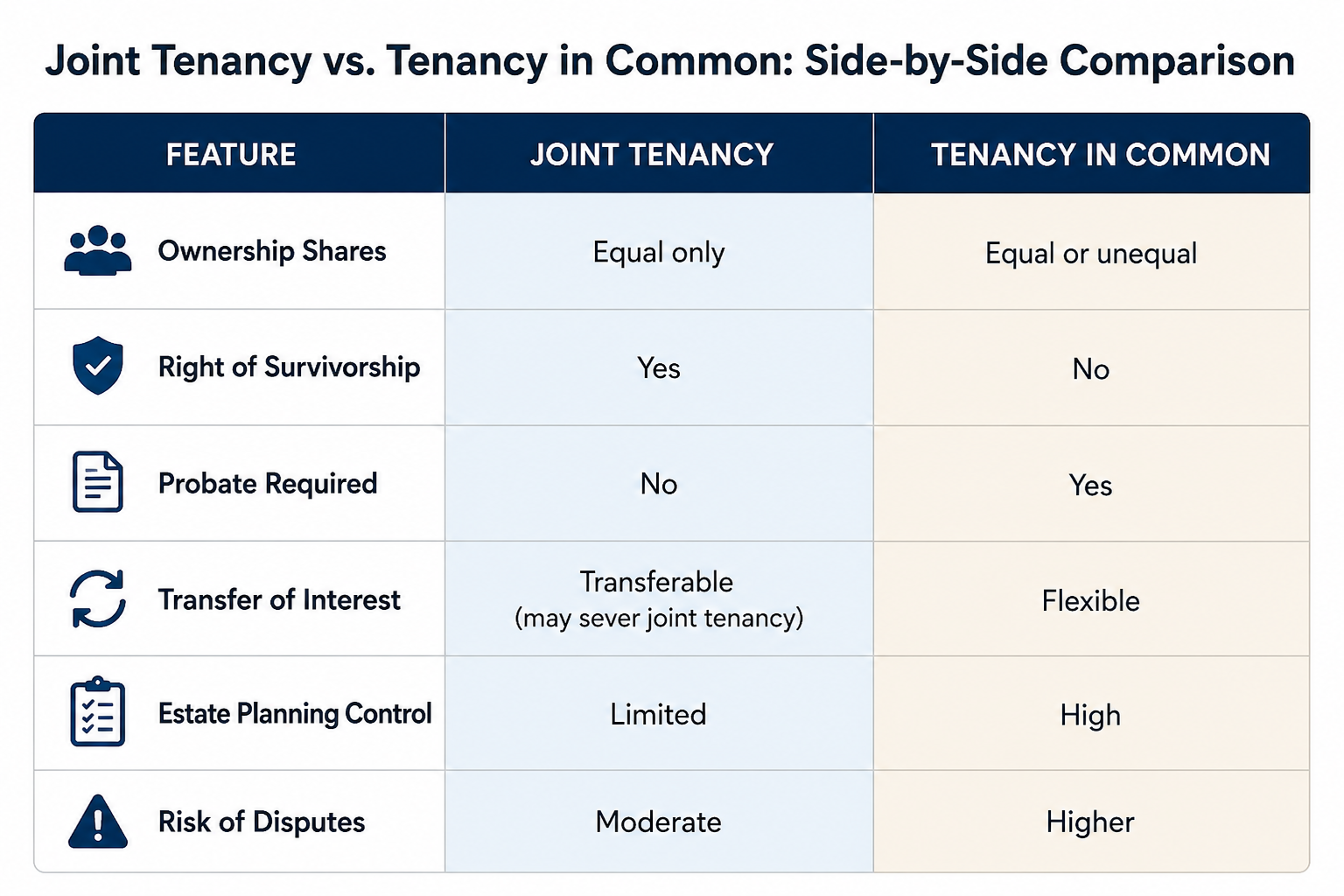
Key differences at a glance:
- Survivorship: Joint tenancy ✔ | Tenancy in common ✘
- Ownership shares: Equal only ✔ | Flexible ✔
- Probate: Avoided ✔ | Required ✔
- Transfer rights: Transferable (may sever joint tenancy) ✔
Choosing the right structure can significantly impact your estate plan, financial exposure, and ability to manage or sell the property.
What Is Co-Ownership of Property in Arizona?
Co-ownership occurs when two or more individuals hold title to the same property. This is common among:
- Spouses
- Family members
- Business partners
- Real estate investors
While co-ownership may seem straightforward, the way title is held determines what happens when an owner dies, how disputes are resolved, and whether a co-owner can force a sale of the property.
Joint Tenancy in Arizona
Definition
Joint tenancy is a form of ownership where all co-owners hold equal, undivided interests in the property, along with a right of survivorship.
Key Legal Characteristics
- Equal ownership shares among all tenants
- Right of survivorship (ownership automatically transfers upon death)
- Requires the “four unities”:
- Time (acquired at the same time)
- Title (same deed)
- Interest (equal shares)
- Possession (equal rights to use the property)
Advantages of Joint Tenancy
- Avoids probate upon death of an owner
- Provides a simple transfer of ownership
- Often used by married couples, although Arizona law also recognizes community property with right of survivorship.
Risks and Limitations
- Loss of control over inheritance — you cannot leave your share to heirs
- Exposure to co-owner creditors
- Severance risk — a co-owner can break the joint tenancy without consent
- Potential tax consequences depending on circumstances
When Joint Tenancy Makes Sense
- Married couples seeking simplicity
- Situations where survivorship is the primary goal
- Low-risk co-ownership arrangements with high trust
Tenancy in Common in Arizona
Definition
Tenancy in common allows co-owners to hold separate ownership interests, which may be equal or unequal, without survivorship rights.
Key Legal Characteristics
- Ownership shares can be unequal
- Each owner may sell, transfer, or encumber their interest independently
- Ownership passes through probate upon death
Advantages of Tenancy in Common
- Flexible ownership percentages
- Greater control over estate planning
- Easier to transfer or sell ownership interests
Risks and Limitations
- Probate is typically required upon death
- Higher likelihood of disputes among co-owners
- Increased risk of partition actions (forced sale of property)
When Tenancy in Common Makes Sense
- Investment properties with multiple partners
- Situations requiring unequal ownership
- Estate planning strategies involving trusts or heirs
Key Legal Risks of Co-Ownership in Arizona
Partition Actions (Forced Sale of Property)
One of the most important risks in any co-ownership arrangement is that any co-owner can file a partition action. This is a legal process that may result in:
- Forced sale of the property
- Division of proceeds among owners
- Litigation costs and delays
Partition actions frequently arise in tenancy in common arrangements.
Creditor Claims
A creditor of one co-owner may:
- Place a lien on that owner’s interest
- Force legal action involving the property
The impact can differ significantly depending on how title is held, including whether a creditor can force sale or only attach to an individual ownership interest.
Disputes Between Co-Owners
Common disputes include:
- Property maintenance responsibilities
- Payment of expenses
- Timing of sale or refinancing
Without a clear agreement, these issues often escalate into litigation.
Estate Planning Considerations
The choice between joint tenancy and tenancy in common has significant estate planning implications:
- Joint tenancy:
- Avoids probate
- Limits control over inheritance
- Automatically transfers ownership
- Tenancy in common:
- Allows transfer through a will or trust
- Enables more strategic estate planning
- Requires probate unless otherwise structured
Selecting the wrong structure can unintentionally override your estate plan.
How to Change Property Ownership in Arizona
Property ownership structure can often be modified through:
- Quitclaim deeds
- Severing a joint tenancy
- Creating a tenancy in common agreement
However, these changes can have legal and tax consequences, so they should be handled carefully.
Arizona Laws Governing Co-Ownership
Arizona law recognizes both joint tenancy and tenancy in common under statutes such as:
- Arizona Revised Statutes § 33-431 (Joint tenancy and survivorship)
Understanding how these laws apply to your situation is essential before acquiring or transferring property.
Practical Tips Before Choosing a Co-Ownership Structure
Before deciding how to hold title, consider:
- Your long-term estate planning goals
- Whether you want automatic transfer at death
- The level of trust between co-owners
- How disputes will be handled
- Whether you have a clear exit strategy
Formal agreements between co-owners are strongly recommended.
Frequently Asked Questions
What is the main difference between joint tenancy and tenancy in common in Arizona?
The most important difference is what happens when an owner passes away. In a joint tenancy, the surviving owner automatically receives the deceased owner’s interest through the right of survivorship. In a tenancy in common, there is no survivorship right, and each owner’s share becomes part of their estate.
Arizona law generally treats co-ownership as tenancy in common unless the deed clearly states joint tenancy with right of survivorship.
Can a joint tenant sell or transfer their interest without permission?
Yes. A joint tenant has the ability to transfer their ownership interest without approval from the other owner. However, this type of transfer can have significant legal consequences.
In many cases, transferring an interest will sever the joint tenancy. Once severed, the ownership typically converts into a tenancy in common, and the right of survivorship is eliminated. This is one of the most common ways joint tenancy arrangements unintentionally change over time.
Does tenancy in common avoid probate in Arizona?
No. Tenancy in common does not provide any automatic transfer of ownership upon death. Each owner’s share becomes part of their estate and will generally go through probate unless separate estate planning tools are used.
This is one of the key tradeoffs. Tenancy in common offers flexibility during ownership but often requires additional legal steps after death.
Can a co-owner force the sale of property in Arizona?
Yes. Any co-owner has the legal right to file a partition action to force the sale of the property.
This type of dispute commonly arises when co-owners disagree about whether to sell, how the property should be managed, or how expenses should be shared. If the court orders a sale, the property is typically sold and the proceeds are divided among the owners, even if one party objects.
Is joint tenancy always the best option for married couples?
Not necessarily. Joint tenancy is often used because it allows property to transfer automatically upon death, but it is not the only option available in Arizona.
Arizona law also allows married couples to hold property as community property with right of survivorship, which can provide both probate avoidance and potential tax advantages when structured properly.
The right structure depends on the couple’s overall estate plan, financial goals, and how they want their property handled in the future.
What happens if a deed is unclear or does not specify the ownership type?
If a deed does not clearly establish joint tenancy with right of survivorship, Arizona courts will generally treat the ownership as tenancy in common.
This can significantly affect how the property is handled after an owner’s death. Instead of transferring automatically, the interest may pass through probate and be distributed according to a will or Arizona law.
Which ownership structure is better for real estate investors or business partners?
In many situations, tenancy in common is the more practical choice for investors and business partners. It allows for unequal ownership shares, independent transfers, and greater flexibility when entering or exiting an investment.
That flexibility also creates risk. Without a clear written agreement, disagreements over management, expenses, or sale decisions can quickly lead to disputes or litigation
How do I choose the right ownership structure for my situation?
There is no universal answer. The appropriate structure depends on your estate planning goals, your relationship with the other owner, and your long-term plans for the property.
This decision should be made carefully. The way you hold title affects your rights during ownership, your exposure to risk, and what happens to the property in the future. Choosing the wrong structure can create unintended consequences that are difficult to fix later.
Speak With an Arizona Real Estate Attorney
Choosing how to hold title to property is not just a technical decision—it is a legal and financial strategy that can have long-term consequences.
At Gottlieb Law, we assist clients with:
- Property ownership structuring
- Real estate disputes and partition actions
- Title and ownership litigation
- Strategic estate-related property decisions
If you are buying property with others or reevaluating your current ownership structure, we can help you make informed, legally sound decisions.
Contact our firm today at 602-899-8188 to schedule an initial consultation or make an appointment online.
Gottlieb Law, PLC provides this article for informational purposes only. Reading it does not create an attorney-client relationship, and you should not act or rely on any of the information herein without first consulting qualified legal counsel. Laws and local procedures change frequently. Always seek legal advice specific to your situation.