
Real Estate Law

Adverse Possession in Arizona - Gottlieb Law

Adverse Possession in Arizona: Can Someone Legally Take Your Land?

Adverse Possession in Arizona: Can Someone Legally Take Your Land? 1536 1024 Gottlieb Law

Gottlieb Law, PLC provides this article for information purposes only and nothing herein creates an attorney-client relationship. You should not take any actions in reliance on any of the information contained herein without consulting with qualified legal counsel first and reading this article is not a proper substitute for seeking legal advice of your specific situation.  Laws change over time and you should seek counsel to discuss any specific legal questions.


Most people don’t think about land ownership in legal terms until a fence line, driveway, or strip of desert becomes a fight. It usually starts small. A neighbor maintains an area. Someone has been parking in a side lot for years. A fence is installed where it “seems right,” and then nobody questions it until a survey is conducted during a sale.

That’s where adverse possession enters the conversation. It’s a legal doctrine that can allow someone to gain rights to land through long-term possession, but only if strict requirements are met. It isn’t automatic, and it’s not a loophole that lets a random person steal property overnight. Still, it can become a real threat when boundaries are unclear, owners are absentee, or neighbor use has gone unchallenged for a long time.

This article is general information, not legal advice. Adverse possession disputes are fact-heavy, and small details can decide the outcome. If you’re dealing with an active boundary conflict, a threatened claim, or a transaction that depends on a clean title, a fast legal review from an experienced Arizona real estate attorney can save you time and help prevent expensive mistakes.

What Adverse Possession Means In Arizona

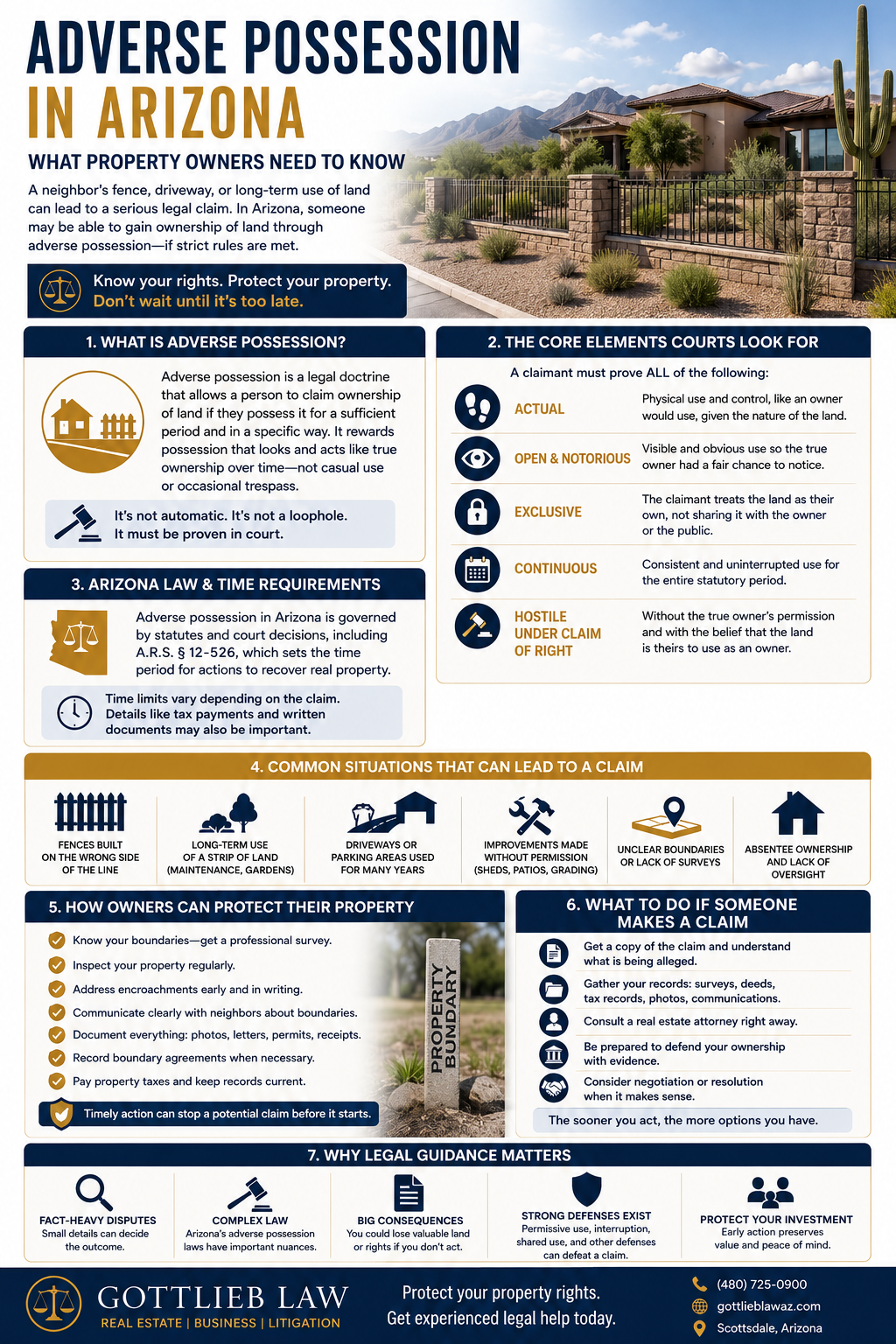
Adverse possession is a legal concept in which a person who possesses land for a sufficient period and in a specific way may be able to claim legal ownership of that land. The idea is rooted in the possession that looks and functions like true ownership over time, not casual use or occasional trespass.

In Arizona, adverse possession is governed by statutes and court decisions that define the required elements and timeframes.  Arizona law provides different time requirements depending on the facts and the legal theory being asserted.  In general terms, this statute addresses the time period for bringing an action to recover real property, which is closely tied to how adverse possession claims are evaluated. 

The idea is straightforward: if an owner waits too long to enforce their property rights after another person has been occupying the land in a way that meets the legal standard, the owner’s ability to recover that land can be barred. That time component is only part of the picture, though. A claimant must still show the required type of possession throughout the statutory period, and courts will closely examine evidence such as boundary markings, improvements, maintenance patterns, access controls, and whether the true owner gave permission at any point.

The important point for property owners is that adverse possession claims are not based on feelings or handshakes. They are based on proof. If someone is asserting a claim, the court will look at what the person did on the land, how long they did it, whether the use was obvious, and whether the true owner permitted it or challenged it.

The Core Elements Courts Look For In An Adverse Possession Claim

Adverse possession cases rise or fall on the elements. People often focus on the number of years, but time alone won’t carry the claim if the possession doesn’t meet the legal standard.

Courts typically look for possession that is actual, open and notorious, exclusive, continuous for the statutory period, and hostile under a claim of right. Those terms sound technical, but the real-world meaning is easier to understand if you picture what ownership looks like day-to-day.

Actual possession generally means physical use and control. It’s not enough to walk across a corner once in a while. The claimant’s use must look like the kind of use an owner would make, given the nature of the land. That could mean fencing, maintaining, building improvements, storing materials, grading, or otherwise treating the area as their own.

Open and notorious means visible. The true owner must have had a fair chance to notice the use. Secret use doesn’t support a claim. If an owner could reasonably look at the property and see what’s happening, this element is more likely to be satisfied.

Exclusive means the claimant is treating the land as their own, not sharing it freely with the true owner or the public in a way that would undermine the claim. Shared use often creates defenses for the owner, especially if the owner can show they also used the area.

Continuous means consistent over the required time period. A claim can collapse if use was intermittent, abandoned, or meaningfully interrupted. The timeline is one of the most contested parts of these cases because people remember history differently, and documents don’t always exist.

Hostile under claim of right is often misunderstood. It doesn’t require personal hostility or conflict. It generally means possession occurred without the true owner’s permission and under the claim that the land is the claimant’s to use as an owner would. Permission is a major issue here, and it’s one reason friendly neighbor arrangements can backfire later.

Here’s the practical takeaway. If the use appears to be ownership, remains consistent for years, is visible, and wasn’t permitted, an owner should take it seriously.

Time Requirements And The Role Of Taxes And Paperwork

People usually ask one question first: “How many years does it take?” Arizona’s rules depend on the situation, and the details can matter more than the headline number. The statutory framework in A.R.S. 12-526 is a key starting point, and real cases require matching the facts to the correct legal theory.

Taxes and paperwork can also matter, depending on how the claim is framed. In some situations, payment of property taxes and the presence of written instruments can become important facts in the dispute. In other situations, the dispute centers more on possession behavior and whether the owner effectively abandoned control of the disputed area.

If you’re trying to protect land, the practical lesson is simple. Documentation and timelines are the oxygen in these disputes. Surveys, dated photos, permits, receipts, maintenance records, and written communications often become more persuasive than memory. If you’re defending against a claim, proving interruptions, shared use, or permission can be just as important as challenging the timeline itself.

Common Adverse Possession Scenarios We See In Arizona

Adverse possession issues often aren’t about someone trying to take an entire parcel. Many disputes involve narrow strips of land that people treat as part of their yard, driveway, or access route for years.

Fence line encroachments are the classic scenario. A fence is installed off the true line, landscaping grows in, sprinklers get installed, and years pass without a survey. The neighbor behind the fence starts thinking of that strip as theirs, and their actions may reinforce that belief.

Driveways and access routes also give rise to claims. A neighbor may use a side driveway, a cut-through, or a turnaround area for years, and the use can start to look permanent. In rural areas, long-term use of paths, gates, grading, and storage can blur boundaries even faster, especially where lines aren’t clearly marked on the ground.

Vacant land creates a different kind of risk. If a property owner doesn’t visit or inspect regularly, a neighbor’s use can grow from minor to substantial without resistance. Over time, that can shift the story from “they borrowed it” to “they treated it as theirs.”

Multi-parcel and investor-owned properties can be vulnerable too. Maintenance crews may mow or maintain over a line without anyone realizing it. Tenants may use areas they don’t legally control. If nobody audits the boundaries, the habits become “the way it’s always been.”

What Counts As Permission And How It Can Defeat A Claim

Permission is often one of the strongest defenses to an adverse possession claim.  If the true owner permits the use, the possession is generally not “hostile” in the legal sense, even if the neighbor later acts as if entitled.

This is where casual neighbor relationships can create long-term complications. A homeowner might say, “Sure, use that corner,” or “Go ahead and park there,” and never document it. Years later, the property changes hands, memories fade, and the friendly arrangement turns into a dispute with no paper trail.

Written permission, license agreements, leases, boundary agreements, and even clear text messages can help show that the use was allowed. In addition, evidence of shared use can support the argument that the neighbor wasn’t acting as the exclusive owner.

If you’re an owner and you want to keep things friendly while staying protected, the goal is clarity. Clear boundaries, written permission when appropriate, and regular property checks can prevent a minor accommodation from turning into a title problem.

How Adverse Possession Disputes Usually Surface

These disputes often surface at the worst possible time. A survey happens for a sale. A buyer’s lender requires boundary confirmation. A homeowner pulls permits for an addition. A neighbor replaces a fence, and somebody finally measures.

In escrow, a new survey or inspection can expose an encroachment that’s been ignored for years. Once the issue is visible in documents, it becomes harder to ignore. Title companies may require resolution before insuring. Buyers may demand credits or repairs. Lenders may pause underwriting.

Outside escrow, disputes also surface after neighbor relationships break down. What felt like normal sharing can turn into a hard boundary conflict after a disagreement, a divorce, an inheritance, or a new owner moving in next door.

What Property Owners Should Do If They Suspect An Adverse Possession Issue

If you suspect a boundary issue, your best move is to get organized and get accurate. Guessing can make it worse, especially if you confront a neighbor without facts and accidentally create admissions or inconsistent statements.

Obtaining a survey from a qualified professional is often an important early step.  In many cases, it’s the first objective step that cuts through years of assumptions. Then document the current conditions with dated photos and notes. Capture fences, landscaping, improvements, access paths, and anything that shows how the land is being used.

Next, gather your ownership documents. Deeds, prior surveys, title documents, permits, boundary agreements, and communications all matter. If the disputed strip has changed hands or the property has been modified, those records may help reconstruct the timeline.

If a dispute is active, keep communication controlled and factual. Escalating the conflict on social media, arguing in the yard, or sending angry messages can create evidence that hurts your position. A structured legal approach is usually more effective than an emotional back-and-forth.

Here are smart early steps that protect owners and preserve options.

  • Order a professional survey, and keep copies of the report and supporting documents.
  • Photograph the boundary area and improvements, and record dates for your files.
  • Gather deeds, prior surveys, title records, permits, and written communications.
  • Avoid informal permission conversations that create confusion or mixed signals.
  • Contact counsel early if there is a threatened claim or a transaction deadline.

What Buyers And Sellers Should Know Before Closing

Adverse possession risk is not only a neighbor problem. It’s a transaction risk. Buyers want to know they’re buying what they think they’re buying, and lenders want collateral that matches the legal description.

Buyers should consider surveys and boundary reviews during due diligence, especially for properties with older fences, long driveways, rural acreage, or visible use along the edges. If you see improvements that look like they cross a boundary, don’t assume it’s harmless. Get it evaluated before contingencies expire.

Sellers should avoid last-minute surprises. If you know there’s a boundary issue, address it early. Waiting until the final week of escrow can kill deals, create price concessions, and put you under pressure to settle quickly.

Titles, surveys, and boundary clarity are easier to manage at the front of a transaction than at the end.

How These Claims Get Resolved In The Real World

Many disputes are resolved without a full trial, but resolution still requires clean documentation and proper legal steps. Some cases settle through boundary line agreements, deeds, or negotiated adjustments that clarify ownership and remove future uncertainty. Other cases require quiet title actions or court involvement when parties can’t agree.

The practical goals are usually the same. Clear title. Clear boundaries. No future surprises when the property sells again.

The best resolution path depends on the evidence, the timeline, and the value of the disputed land. A narrow strip may justify a pragmatic settlement. A meaningful portion of land may require aggressive defense or a formal title action.

Adverse Possession in Arizona Infographic - Gottlieb Law


Get A Clear Strategy Before The Dispute Gets Expensive

If you’re dealing with a boundary dispute, an encroachment, a threatened adverse possession claim, or a transaction impacted by a survey surprise, Gottlieb Law can help you get clarity fast. A focused review of the facts, documents, and timeline can show whether you have strong defenses, whether the issue can be settled cleanly, and what steps protect your ownership rights. Contact us online to schedule a consultation or call us at: 602-899-8188.

Frequently Asked Questions About Adverse Possession in Arizona

What Is Adverse Possession In Arizona?
It’s a legal doctrine where someone may claim ownership of land through long-term possession that meets specific legal requirements. Time alone isn’t enough. The claimant must prove the required elements with evidence.

How Many Years Does Adverse Possession Take In Arizona?
It depends on the facts and the legal theory being applied. People often want a single number, but courts focus on continuous possession and proof. Reviewing the specific facts with qualified legal counsel is the safest approach. 

Can Someone Take My Land If I Never Gave Permission?
Lack of permission is often part of the analysis, but the claimant still must prove every required element. Many claims fail because the use wasn’t exclusive, wasn’t continuous, or wasn’t clearly ownership-like. Owners who act early often have stronger defenses.

Does Paying Property Taxes Matter For Adverse Possession?
Taxes and documentation can matter in certain cases, depending on how the claim is framed. Courts look at the full record, not one factor in isolation. A claim can weaken quickly if paperwork and timelines don’t align.

What If A Fence Is On The Wrong Property Line?
A fence alone doesn’t automatically transfer ownership. It can become evidence of long-term possession if other elements are met over time. A survey and dated documentation are usually the first practical steps.

Can Adverse Possession Happen On Vacant Land?
Yes, especially when owners don’t monitor boundaries. The claimant still has to show actual, visible, continuous use that appears to be ownership. Regular inspections and clear boundary markers reduce the risk.

Can A New Owner Stop An Adverse Possession Claim?
Buying the property doesn’t erase past facts, but new owners can take steps to protect their rights going forward. Surveys, notices, and boundary documentation can help prevent continued possession. Fast action matters if you discover an issue after closing.

Can Adverse Possession Claims Be Settled Without Going To Court?
Yes, many disputes are resolved through negotiated agreements, deeds, or boundary line adjustments. Settlement can save time and reduce costs, especially for small boundary areas. Any agreement should be documented properly to prevent future disputes.


Gottlieb Law, PLC provides this article for information purposes only and nothing herein creates an attorney-client relationship. You should not take any actions in reliance on any of the information contained herein without consulting with qualified legal counsel first and reading this article is not a proper substitute for seeking legal advice of your specific situation.  Laws change over time and you should seek counsel to discuss any specific legal questions.

Disputes Among Real Estate Partners or Investors - Gottlieb Law

Disputes Between Real Estate Partners or Investors

Disputes Between Real Estate Partners or Investors 1491 1055 Gottlieb Law

Gottlieb Law, PLC provides this article for information purposes only and nothing herein creates an attorney-client relationship. You should not take any actions in reliance on any of the information contained herein without consulting with qualified legal counsel first and reading this article is not a proper substitute for seeking legal advice of your specific situation.  Laws change over time and you should seek counsel to discuss any specific legal questions.


Real estate partnerships usually begin with confidence. The numbers look strong. The property has potential. Everyone agrees on the upside. Then the real work begins, and suddenly the deal isn’t just about the building or land anymore. It’s about control, money, risk, trust, timing, and who gets to make the final call.

Disputes between real estate partners or investors can get heated fast because the stakes are rarely small. A disagreement over repairs, refinancing, rental income, property management, or a sale can quickly put the entire investment at risk. For owners, co-investors, developers, and business partners, the smartest move is to understand where these disputes come from and how to protect your position before the conflict becomes more expensive and potentially litigious.

Why Real Estate Partner Disputes Happen

Many real estate disputes start with unclear expectations. One partner may believe the property should be held long term, while another wants to sell as soon as the market improves. One investor may expect regular distributions, while another believes profits should be reinvested in renovations, upgrades, or debt reduction.

Trouble also starts when the written agreement is vague or incomplete. If the operating agreement or partnership agreement doesn’t clearly explain voting rights, management authority, capital contributions, buyout options, and dispute resolution procedures, partners are left arguing over assumptions.

That’s where business relationships often begin to crack. A handshake deal may feel simple at first, but it can become a serious liability once the property needs money, tenants complain, repairs pile up, or one investor wants out.

Common Disputes Between Real Estate Partners and Investors

Real estate partner disputes can take many forms. Some involve simple communication breakdowns. Others involve serious claims of misconduct, fraud, or breach of fiduciary duty.

Common conflicts include disagreements over property management, missed capital contributions, unpaid expenses, profit distributions, leasing decisions, refinancing, buyouts, sale timing, accounting records, and unauthorized decisions. In commercial real estate, partners may also dispute tenant improvements, vendor contracts, vacancy strategy, rent collection, zoning issues, or development timelines.

The core problem is usually control. Who has authority? Who gets paid? Who decides whether the property is sold, refinanced, repaired, leased, or improved? If those answers aren’t clear, the dispute can stall the investment and damage the property’s value.

Money, Contributions, and Accounting Problems

Money disputes are some of the most common and most damaging conflicts between real estate partners. One partner may stop contributing to expenses. Another may claim they paid more than their fair share. A managing partner may fail to provide financial records, leaving investors wondering where the money went.

These disputes often involve mortgage payments, property taxes, insurance, repairs, utilities, vendor invoices, legal fees, management costs, and emergency expenses. If rental income is coming in, investors may also argue about whether profits should be distributed or kept in reserve.

Clean records are important. Bank statements, invoices, rent rolls, tax returns, emails, payment records, and distribution reports can become critical evidence. Without a paper trail, partners may struggle to prove what was paid, what was owed, and whether money was handled properly.

Management and Control Disputes

Not every real estate partner plays the same role. One person may handle daily operations while another contributes capital. That setup can work beautifully until the passive investor starts questioning the active partner’s decisions.

Management disputes often involve repairs, leases, tenant communication, vendor selection, maintenance standards, property managers, budgets, and spending authority. One partner may believe that the other is neglecting the property. Another may believe a partner is overspending or making decisions without approval.

These conflicts can become especially serious if one partner controls the books, bank account, tenant relationships, or property access. A partner or manager with control may owe legal duties to others depending on the governing agreements, the entity structure, and the circumstances.

Sale, Buyout, and Refinancing Disputes

Some of the toughest disputes arise when one partner wants to sell and the other wants to hold. This can happen due to market changes, personal financial pressures, tax concerns, retirement plans, or disagreements over the property’s future.

A buyout may seem like the obvious solution, but buyouts can create their own fights. Partners may disagree about property value, appraisers, debt, discounts, payment timing, personal guarantees, and whether one side is being treated fairly.

Refinancing can create another layer of tension. One investor may want to pull out equity. Another may not want to take on more debt. If the agreement doesn’t explain how these decisions are made, the partnership may hit a deadlock.

Breach of Contract and Fiduciary Duty Claims

If a partner violates the operating agreement, partnership agreement, purchase agreement, or another binding document, the dispute may become a breach-of-contract claim. Examples include failing to fund required contributions, refusing to provide records, making unauthorized transfers, blocking required signatures, or ignoring buy-sell terms.

Depending on the governing agreements, entity structure, and applicable law, fiduciary duty claims can also arise when a partner with authority acts in their own interest rather than in the partnership’s or its investors’ best interests. This may include self-dealing, hiding information, taking secret profits, using related vendors without disclosure, misusing funds, or cutting side deals connected to the property.

These claims are serious because they go beyond ordinary disagreement. They question whether someone abused trust, control, or authority.

Legal Options for Resolving Real Estate Partner Disputes

Not every real estate dispute needs to become a full lawsuit. Many conflicts can be addressed through negotiation, demand letters, mediation, arbitration, accounting demands, or buyout discussions. The right strategy depends on the agreement, the property, the financial damage, and whether immediate court action is needed.

In more serious cases, litigation may be necessary. A court may be asked to enforce an agreement, order an accounting, stop unauthorized conduct, appoint a receiver, award damages, dissolve an entity, or force the sale of jointly owned property through a partition action.

The goal should always be practical. Sometimes that means preserving the investment. Sometimes it means separating the partners. Sometimes it means moving quickly before more money disappears or the property loses value.

How to Protect Yourself Before the Dispute Gets Worse

Real estate partners and investors should avoid acting on emotion. Don’t lock someone out, drain accounts, transfer assets, send threatening messages, or make major decisions without first reviewing the agreement.

Start gathering documents. Save contracts, emails, text messages, deeds, bank statements, rent records, invoices, tax documents, loan papers, and investor reports. Then speak with a real estate litigation attorney who can explain your rights, review the agreement, and help you choose the strongest path forward.

A real estate dispute can threaten more than one deal. It can affect your money, reputation, credit, business relationships, and future investment opportunities. The sooner you take the conflict seriously, the more options you may have.

Protect Your Investment Before the Dispute Gets Worse

A real estate partnership dispute can put your money, property, business relationships, and future investment plans at risk. Whether the conflict involves a co-owner, investor, developer, business partner, or managing member, waiting too long can make the situation harder to control. Missing records, unauthorized decisions, unpaid expenses, blocked sales, and financial disagreements can quickly turn a valuable investment into a costly legal battle.

Gottlieb Law represents clients in Arizona real estate litigation, real estate transactions, business law, probate, contract matters, and related disputes. The firm focuses on strategic, results-driven representation for individuals and businesses facing complex legal issues involving property, ownership rights, contracts, and investment interests.

If you’re dealing with a dispute between real estate partners or investors, speak with Gottlieb Law before the conflict escalates. An experienced Arizona real estate litigation attorney can review your agreements, evaluate your rights, protect key evidence, and help you pursue the best path forward, whether that means negotiation, mediation, a buyout, or litigation.

Contact Gottlieb Law today to schedule an initial consultation and take the next step toward protecting your property, your investment, and your legal rights. Schedule a consultation online or call us at: 602-899-8188.

FAQ: Disputes Between Real Estate Partners or Investors

What causes disputes between real estate partners?

Common causes include unclear agreements, disagreements over money, missed contributions, poor accounting, management conflicts, and disputes over whether to sell, refinance, or hold the property.

Can one real estate partner force a sale?

In some situations, a co-owner may be able to pursue a partition action or another legal remedy. The answer depends on the ownership structure, written agreements, and applicable law.

What if a partner is hiding financial records?

A partner or investor may be able to demand an accounting, review records, pursue legal claims, or seek relief from the court, depending on the facts and governing documents.

Is mediation useful in real estate partner disputes?

Yes. Mediation can help partners reach a buyout, sale agreement, accounting resolution, or management plan without the cost and pressure of full litigation.

When should I call a real estate litigation attorney?

You should speak with an attorney if money is missing, records are being withheld, a partner is acting without authority, a sale is blocked, or the property is at risk.


Gottlieb Law, PLC provides this article for information purposes only and nothing herein creates an attorney-client relationship. You should not take any actions in reliance on any of the information contained herein without consulting with qualified legal counsel first and reading this article is not a proper substitute for seeking legal advice of your specific situation.  Laws change over time and you should seek counsel to discuss any specific legal questions.

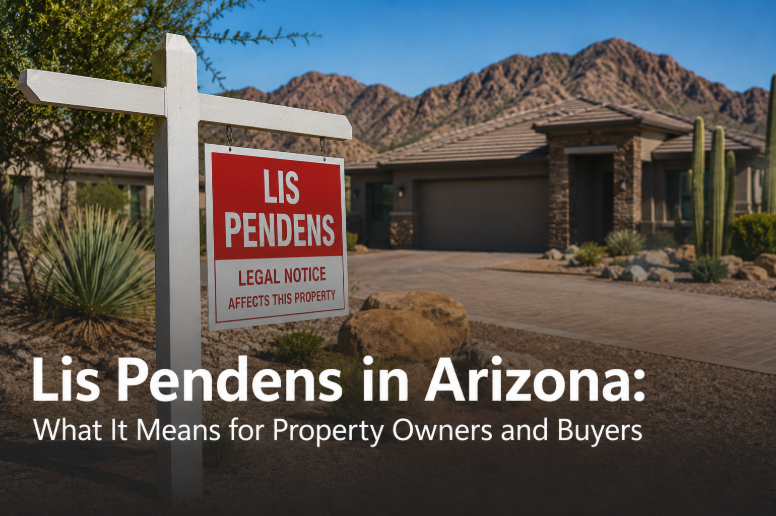
Lis Pendens in Arizona: What It Means for Property Owners and Buyers

Lis Pendens in Arizona: What It Means for Property Owners and Buyers

Lis Pendens in Arizona: What It Means for Property Owners and Buyers 776 516 Gottlieb Law

Gottlieb Law, PLC provides this article for information purposes only and nothing herein creates an attorney-client relationship. You should not take any actions in reliance on any of the information contained herein without consulting with qualified legal counsel first and reading this article is not a proper substitute for seeking legal advice of your specific situation.  Laws change over time and you should seek counsel to discuss any specific legal questions.
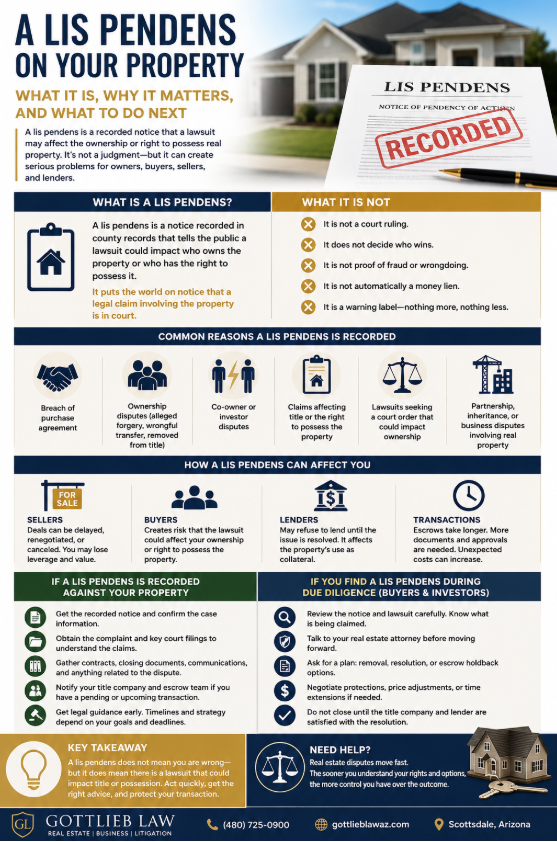
A lis pendens is one of those phrases that can turn a calm real estate transaction into a high-stress scramble. It usually shows up on a title report right before closing, during a refinance, or while an investor is trying to move quickly on a purchase. In plain English, it’s a recorded notice that tells the public there’s a lawsuit involving a claim that may affect the property’s title or the right to possess it.

That doesn’t mean the person who recorded it is right. It doesn’t mean the owner did anything wrong. It doesn’t mean the court has ruled on anything yet. Still, it can cause very real problems because real estate relies on a clear title and predictable risk. Once a lis pendens is recorded, buyers hesitate, lenders become cautious, and title companies typically flag it as a significant issue, and many transactions require it to be resolved before closing.

This is general information, not legal advice. If you’re dealing with an active escrow, a rate lock, or a time-sensitive purchase, getting the recorded notice and the underlying lawsuit reviewed quickly by qualified legal counsel is often the fastest way to get control of the situation.

What A Lis Pendens Is And What It Is Not

A lis pendens is a notice recorded in county records that’s connected to a lawsuit involving the property. Its job is to put the public on notice that the lawsuit could impact who owns the property or who has the right to possess it. Because it’s recorded, it tends to appear on title reports and becomes part of the public record tied to the parcel.

It’s not a judgment. It’s not proof of fraud. It’s not a final determination of ownership. Think of it as a warning label that tells the market there’s an unresolved legal claim that might change property rights.

It also isn’t the same thing as a money lien. People mix these up because both can disrupt a transaction, but they’re different tools with different purposes. A lis pendens is tied to litigation over a property interest, not simply an unpaid bill.

In Arizona, a lis pendens generally must be tied to a lawsuit that actually seeks to affect title, ownership, or possession of the property—not simply a dispute over money.

  • It’s a recorded notice tied to a lawsuit involving a property claim.
  • It isn’t a court ruling, and it doesn’t decide who wins.
  • It isn’t automatically a money lien, even if it clouds title in practice.

Common Reasons A Lis Pendens Gets Recorded

Most lis pendens situations arise from disputes where someone claims a right connected to the property itself. A common example is a broken purchase agreement in which one party claims the right to enforce the contract and complete the sale. Another example is an ownership dispute, including contested transfers, alleged forged documents, or claims that someone was wrongfully removed from title.

Business and co-owner disputes also show up often. Investors fall out. Family members disagree after an inheritance. Co-owners disagree on whether to sell. If the lawsuit asks the court to decide ownership or possession rights, or to order a transfer that affects title, a notice may appear.

Not every real estate disagreement supports recording a lis pendens. That’s where things can get messy, especially when one side uses the notice as leverage to pressure the other side during negotiations.

How A Lis Pendens Can Affect Selling, Buying, And Financing

The practical impact is usually fast and obvious. Once the notice shows up, many buyers slow down or pause. Title companies flag it because it raises questions about a marketable title. Lenders can treat it as a major underwriting problem because the property is the collateral for the loan, and they want that collateral clean.

For sellers, this can mean the deal gets delayed, renegotiated, or lost entirely. Even if you believe the lawsuit is weak, the buyer may not want to bet their down payment and future ownership on your confidence. For buyers, it creates a risk that the lawsuit could later affect their ownership or right to possess the property. For refinances and home equity loans, lenders may refuse to fund until the issue is cleared.

Here’s what often happens in real transactions.

  • Escrow timelines stretch because everyone needs more documents and answers.
  • Buyers ask for price changes, additional protections, or removal before closing.
  • Lenders and title insurers may pause until the title risk is addressed.
  • Sellers can lose leverage if they’re under time pressure to close.

What Property Owners Should Do If A Lis Pendens Is Recorded Against Their Property

If you’re the owner, the biggest mistake is treating this as a public relations issue rather than a legal or title issue. What matters is the recorded document and what the lawsuit actually claims. Your first move should be to obtain a copy of the recorded notice and confirm the recording details. Next, obtain the complaint in the lawsuit and review the specific property interest being claimed.

If you’re in escrow or preparing to refinance, notify your title company and escrow team so they aren’t learning about it through surprise updates. At the same time, keep your communications factual. Over-explaining or guessing can create confusion that hurts negotiations.

From there, strategy depends on the facts. Some situations call for challenging the notice, especially if the lawsuit doesn’t support it. Other situations call for negotiating a resolution that results in a release being recorded. Timing matters, and your approach should reflect whether you’re trying to protect a current transaction, reduce ongoing damage, or position the case for a faster end.

  • Get the recorded notice and confirm the case information tied to it.
  • Pull the complaint and key filings so you know what’s actually being alleged.
  • Gather contracts, closing documents, and relevant communications in one place.
  • Get legal guidance early if there’s a closing date or financing deadline involved.

What Buyers And Investors Should Do If They Find One During Due Diligence

Buyers should treat a lis pendens as a serious due diligence checkpoint. Start with documentation. Ask for the recorded notice and the lawsuit complaint. Confirm what rights are being claimed and what the plaintiff wants the court to do. A lawsuit seeking to change ownership rights has a different risk profile than a dispute that’s mostly financial.

Next, talk to your lender and title company early. Even if you’re personally comfortable proceeding, the lender may not fund the loan, and the title insurer may not offer the coverage you expect. That reality often decides the deal.

From a deal-making standpoint, buyers usually have three options. Require removal before closing, renegotiate with real protections in writing, or walk away if the risk doesn’t match the upside. The wrong move is acting like the notice is harmless without understanding the lawsuit.

  • Request the notice and complaint, and confirm the claim involves the property interest.
  • Ask your lender and title company what they require to proceed.
  • Keep contingencies in place until the risk is addressed in writing.

Wrongful Or Improper Notices And What That Can Mean

Lis pendens filings can be misused as leverage, especially in disputes that feel personal or high-stakes. If a lawsuit doesn’t truly support a recorded notice against the property, the recording may be challenged. Courts can address improper filings, and there can be consequences in certain circumstances.

Still, outcomes depend on details. The key point is simple. Don’t assume it’s valid just because it’s recorded, and don’t assume it’s invalid just because it feels unfair. Treat it as a document-and-facts problem that needs a direct legal evaluation.

How These Disputes Usually Get Resolved

Most lis pendens situations end in one of a few ways. The lawsuit settles, and the parties record a release. The court dismisses the underlying claim, thereby clearing the notice. The court issues orders that directly address the notice. In some cases, litigation runs to a judgment that clarifies ownership or possession rights.

From a practical viewpoint, resolution is often driven by timing. If a transaction is pending, the pressure to resolve increases. If no transaction is pending, parties may move more slowly. Either way, a clear plan is better than drifting, while the notice continues to disrupt the property’s marketability.

Talk to an Experienced Arizona Real Estate Lawyer If you’re dealing with a recorded lis pendens, a threatened filing, or a stalled transaction tied to a property dispute, Gottlieb Law can help you get clarity quickly. A focused review of the recorded notice and the underlying lawsuit can reveal whether you’re looking at a manageable issue, a serious title risk, or a filing that should be challenged. Contact us online to schedule a consultation or call us at: 602-899-8188.

Talk to an Experienced Arizona Real Estate Lawyer

If you’re dealing with a recorded lis pendens, a threatened filing, or a stalled transaction tied to a property dispute, Gottlieb Law can help you get clarity quickly. A focused review of the recorded notice and the underlying lawsuit can reveal whether you’re looking at a manageable issue, a serious title risk, or a filing that should be challenged. Contact us online to schedule a consultation or call us at: 602-899-8188.

Frequently Asked Questions About Lis Pendens In Arizona

What Does A Lis Pendens Mean?
It’s a recorded notice that a lawsuit may affect the property’s title or possession rights. It doesn’t prove anyone is right. It signals risk that can disrupt a transaction.

Can I Sell A House With A Lis Pendens?
Sometimes, but it often delays or stops sales. Many buyers and lenders won’t proceed until it’s cleared. Many transactions require the issue to be resolved before closing.

How Long Does A Lis Pendens Last?
Usually, until the lawsuit is resolved or a release is recorded. Timelines vary depending on the case and court schedule. If you’re in escrow, delays can add real costs.

Does A Lis Pendens Mean I Lost The Case?
No. It isn’t a judgment or a ruling. It only means litigation is pending that may affect property rights. The court still has to decide the merits.

Can It Stop A Refinance?
Yes, it can. Lenders often pause or deny funding due to title risk. Clearing the issue is commonly required to proceed.

Is It The Same As A Lien?
Not exactly. A lis pendens is a notice of litigation tied to a property claim. Many liens are tied to debts, though both can cloud title and slow deals.

What Should Buyers Do After Finding One?
Get the recorded notice and lawsuit complaint. Ask your lender and title company what they require. Don’t waive contingencies until the risk is addressed.


Gottlieb Law, PLC provides this article for information purposes only and nothing herein creates an attorney-client relationship. You should not take any actions in reliance on any of the information contained herein without consulting with qualified legal counsel first and reading this article is not a proper substitute for seeking legal advice of your specific situation.  Laws change over time and you should seek counsel to discuss any specific legal questions.

 

Commercial Tenant Default: Legal Options For Arizona Landlords

Commercial Tenant Default: Legal Options For Arizona Landlords 1536 1024 Gottlieb Law

Gottlieb Law, PLC provides this article for information purposes only and nothing herein creates an attorney-client relationship. You should not take any actions in reliance on any of the information contained herein without consulting with qualified legal counsel first and reading this article is not a proper substitute for seeking legal advice of your specific situation.  Laws change over time and you should seek counsel to discuss any specific legal questions.

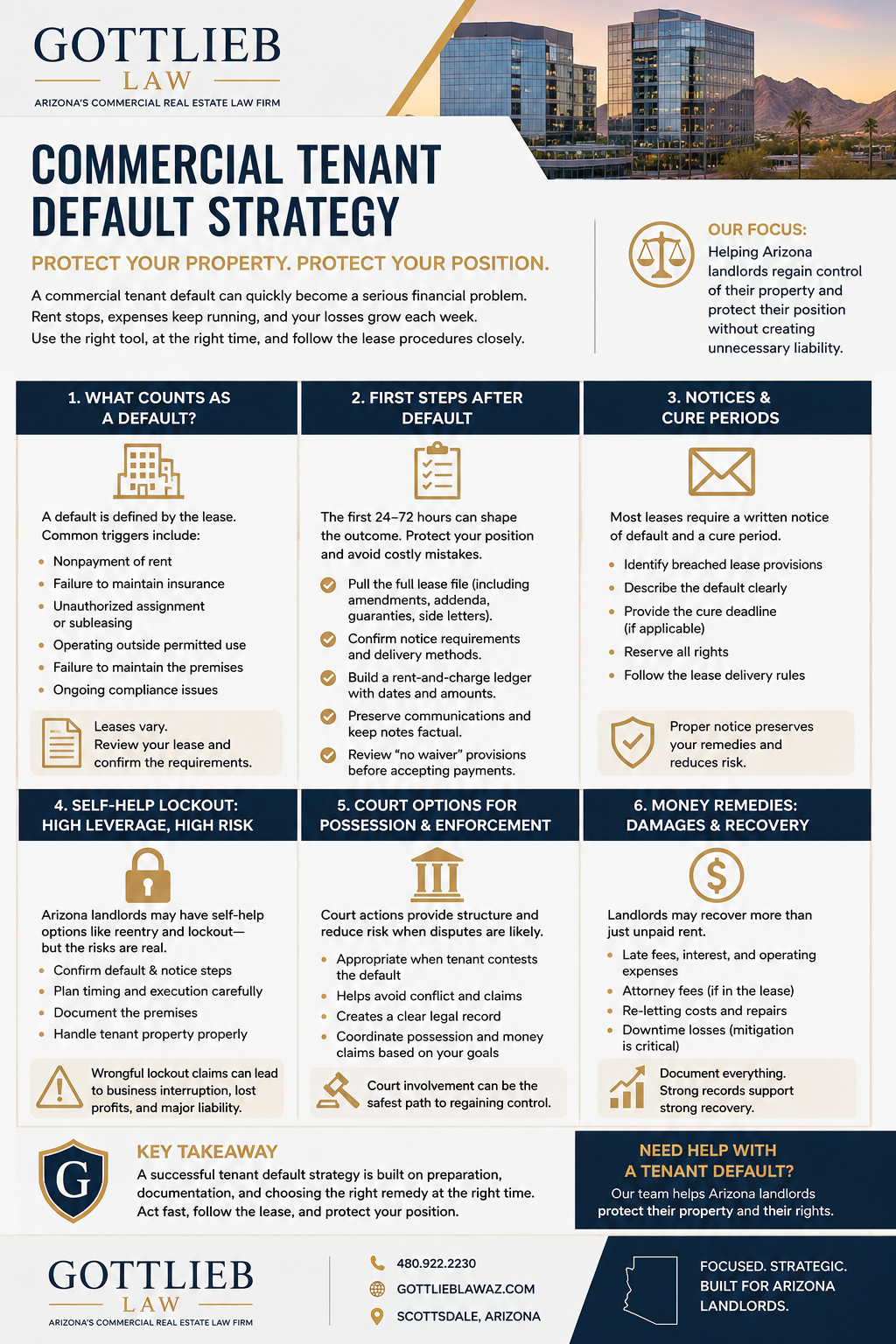
A commercial tenant default can quickly become a serious financial problem. Rent stops, operating expenses keep running, and the tenant may still be in the space while the landlord’s losses grow each week. In Arizona, commercial landlords often
have several legal options, but the best outcome usually comes from using the right tool at the right time and closely following the lease procedures.

At Gottlieb Law, the focus is on helping landlords regain control of the property and protect their position without creating unnecessary liability. The tenant default strategy should be structured, documented, and grounded in facts, not emotion. The lease terms, the tenant’s behavior, and the risk of confrontation all influence the safest and most effective next step.

What Counts As A Commercial Tenant Default In Arizona

A commercial tenant default is typically defined by the lease. Nonpayment of rent is the most common trigger, but many defaults involve non-monetary breaches that can be just as important. Examples include failure to maintain required insurance, unauthorized assignment or subleasing, operating outside the permitted use, failure to maintain the premises, or ongoing compliance problems.

Because commercial leases vary, default procedures vary too. Some leases require formal notice and a cure period before the landlord can pursue specific remedies. Others provide more immediate remedies for certain breaches. A landlord’s leverage can weaken if notice requirements or delivery methods are skipped. That’s why the first step is usually to confirm what the lease requires and to build a clear timeline of what occurred.

The First Steps Landlords Should Take After Default

The initial response to a default can significantly affect the landlord’s options and leverage moving forward. Landlords should aim to protect their position and avoid mistakes that create waiver issues or claims of interference. A disciplined response also helps if the matter ends up in court.

A practical early checklist often includes:

  • Pull the full lease file, including amendments, addenda, guaranties, and any side letters.
  • Confirm notice requirements, including addresses and delivery methods.
  • Build a clean rent-and-charge ledger with dates and amounts.
  • Preserve communications and keep landlord-side notes factual and professional.
  • Review “no waiver” provisions before accepting partial payments or making informal deals.

Documentation is important because it supports whatever option the landlord chooses next, whether it’s negotiation, court action, or a self-help remedy.

Commercial Tenant Default and Legal Options for Landlords in Arizona - Gottlieb Law

Notices, Cure Periods, And Default Letters

Many commercial leases require a written notice of default and provide a cure period. The cure period may differ depending on whether the default is monetary or non-monetary. Even when the landlord believes the tenant has no intention of curing, providing proper notice can help preserve remedies and reduce arguments that the landlord acted prematurely.

A well-prepared default notice typically identifies the breached lease provisions, clearly describes the default, provides the cure deadline, if applicable, and reserves the landlord’s rights. It should also follow the lease’s delivery rules. If the lease requires notice to be sent to a specific address or via a specific method, those details should be treated as mandatory.

Self-Help Lockout In Arizona: High Leverage With High Risk

Arizona commercial landlords may have access to self-help options in certain circumstances, including reentry and lockout, but the lease must permit it. In many situations it is advisable to consult with a real estate attorney prior to engaging in a self-help remedy.  This can be a powerful remedy, but it’s not something to treat casually. The greatest risks come from acting without a valid legal basis, failing to meet notice requirements, or creating a confrontation that escalates into a breach of the peace.

If a lockout is on the table, landlords should approach it like a planned legal procedure. That may include confirming the tenant is actually in default under the lease, evaluating whether notice requirements have been satisfied, and choosing timing and execution methods that avoid conflict. It also means documenting the condition of the premises and handling any tenant property with a careful plan.

A wrongful lockout claim can quickly become expensive. Business interruption allegations, lost profit claims, and disputes over tenant property can turn what started as a rent problem into complex litigation. In many cases, court involvement is a safer choice if the tenant is combative, the facts are disputed, or the property situation is complicated.

Court Options For Possession And Enforcement

Court-based actions can provide structure and reduce risk, especially when the landlord expects a dispute. A court strategy may be appropriate when the tenant contests the default, the landlord expects confrontation, or there are concerns about the tenant’s conduct during enforcement. Court involvement can also help create a clear record that supports re-letting and recovery of damages.

Landlords often pursue possession and money claims on separate but coordinated paths, depending on the facts and the lease. The right approach depends on speed, cost, and risk tolerance. For some landlords, a court route is the most reliable way to regain control without exposing the landlord to unnecessary claims.

Money Remedies: Unpaid Rent, Fees, And Damages

Beyond possession, landlords may seek financial recovery for unpaid rent and other charges owed under the lease. Commercial leases often include legal remedies such as late fees, interest, operating expenses, and attorney fees. Some leases include provisions addressing future rent or damages after termination, although practical recovery depends on the lease language, mitigation efforts, and the tenant’s financial condition.

Landlords should document damages carefully, including re-letting costs, repairs beyond ordinary wear and tear, and any downtime losses resulting from the tenant’s breach. Clear documentation supports negotiation leverage and strengthens a damages case if litigation becomes necessary.

Tenant Property And Left-Behind Items

Tenant property is one of the most sensitive parts of a default scenario. Lockouts and move-outs can leave behind equipment, inventory, and records. Mishandling those items can create liability, even when the tenant is clearly in default. Landlords should avoid impulsive decisions about keeping, disposing of, or selling property and should follow a documented process that aligns with the lease and applicable Arizona law.  Improper handling of tenant property can create separate liability even if the underlying default is valid.

A careful approach usually includes an inventory, photos, controlled access to the premises, and written communication about retrieval procedures. If there’s any doubt about rights or obligations, legal guidance is worth it before taking action.

Bankruptcy Can Change The Timeline Overnight

If a tenant files for bankruptcy, enforcement options can change immediately. The automatic stay may restrict lockouts, collections, and continued enforcement activity. Landlords should assume that bankruptcy requires a shift in strategy and a pause in self-help actions until the landlord’s rights are evaluated and next steps are properly coordinated. Fast action is still important, but it needs to be the right action.

How Gottlieb Law Helps Landlords Take Control Again

Tenant default strategy should focus on control, leverage, and risk management. Some cases resolve through strong notices and negotiation. Others require possession actions, structured lockout planning, or the pursuit of damages. Gottlieb Law helps Arizona commercial landlords evaluate the lease, identify the safest enforcement path, and move quickly without creating avoidable exposure.

If a commercial tenant is in default, the lease language and early steps often decide the landlord’s leverage later. Gottlieb Law can review the lease, confirm notice and remedy options, and help landlords choose a strategy to restore control and protect the landlord’s position. Schedule a consultation online or call us at: 602-899-8188.

Common Questions about Commercial Tenant Default in Arizona

What Is A Commercial Tenant Default In Arizona?
It’s whatever the lease defines as a default, often missed rent or a serious non-monetary breach, like an insurance lapse or unauthorized use.

Can An Arizona Commercial Landlord Lock Out A Tenant For Nonpayment?
Sometimes, but it’s high-risk if done wrong. Notice, timing, and avoiding confrontation are key.

How Much Notice Is Required Before A Landlord Takes Action?
Usually, the lease controls notice and cure periods. Missing a notice step can delay enforcement.

What Makes A Lockout Wrongful?
Acting without a clear default, skipping required notice, or escalating into conflict can trigger liability.

What If The Tenant Won’t Leave After Default?
Landlords can pursue possession through the courts, and often pair that with money claims.

Can A Landlord Recover Attorney Fees And Costs?
Often yes, if the lease has fee-shifting language and the charges are documented.

Can A Landlord Pursue Future Rent?
Sometimes, depending on the lease and mitigation efforts, like trying to re-let the space.

What About Property Left Behind In The Space?
Inventory and document it, control access, and avoid disposing of items without a legal plan.

What If The Tenant Files Bankruptcy?
Enforcement may be paused due to the automatic stay. The strategy should shift immediately.


Gottlieb Law, PLC provides this article for information purposes only and nothing herein creates an attorney-client relationship. You should not take any actions in reliance on any of the information contained herein without consulting with qualified legal counsel first and reading this article is not a proper substitute for seeking legal advice of your specific situation.  Laws change over time and you should seek counsel to discuss any specific legal questions.
Arizona Real Estate Litigation Guide

Arizona Real Estate Litigation Guide: Lawsuits, Property Disputes, and Legal Rights of Owners & Investors

Arizona Real Estate Litigation Guide: Lawsuits, Property Disputes, and Legal Rights of Owners & Investors 1536 1024 Gottlieb Law

Gottlieb Law, PLC provides this article for information purposes only and nothing herein creates an attorney-client relationship. You should not take any actions in reliance on any of the information contained herein without consulting with qualified legal counsel first and reading this article is not a proper substitute for seeking legal advice of your specific situation.  Laws change over time and you should seek counsel to discuss any specific legal questions.

Real estate disputes in Arizona rarely start as lawsuits.

Typically, they begin with something smaller: a contract issue, a boundary question, a title concern, a tenant problem, or a disagreement between co-owners.

Once legal rights become disputed or parties fail to address issues early, these smaller issues can quickly develop into full-scale litigation.

Whether you are dealing with a title problem, a failed transaction, an HOA dispute, or a possession issue, understanding how real estate litigation works in Arizona can help you protect your property, your investment, and your leverage.

This guide outlines the most common real estate disputes, explains how litigation typically progresses in Arizona, and provides practical steps property owners and investors can take early to avoid unnecessary risk and expense.

What Is Real Estate Litigation in Arizona?

Real estate litigation involves legal conflicts over property rights, use, agreements, or possession that may ultimately require court involvement to resolve.

These disputes commonly involve:

  • Ownership or title to property
  • Rights to use or access land
  • Real estate purchase or sale agreements
  • Landlord–tenant or possession issues
  • HOA enforcement or restrictions
  • Construction or development conflicts

In Arizona, these cases are typically handled in Superior Court and can directly affect your ability to:

  • Keep or transfer ownership
  • Sell or refinance property
  • Access or use land
  • Recover or lose major financial value

Understanding how these disputes arise and are handled is the first step toward protecting your rights and making well-informed decisions when a real estate conflict develops.

Arizona Real Estate Litigation Checklist

When a real estate dispute arises, the outcome often depends on a handful of key legal factors. Knowing what Arizona courts focus on allows you to evaluate your position early and make informed, strategic decisions.

Courts will generally assess:

  • Whether valid legal rights or ownership exist
    • Who actually has enforceable rights to the property based on deeds, title records, or law
  • What contracts or documents control the situation
    • Purchase agreements, leases, HOA rules, easements, or other governing documents
  • Whether one party failed to meet its legal obligations
    • A breach of contract, violation of property rights, or failure to comply with legal duties
  • Whether immediate legal action is necessary
    • Situations involving possession, access, or risk of losing rights may require fast action
  • What legal remedy is appropriate
    • Financial damages, court orders, court-ordered sales, or other equitable relief depending on the case

Identifying how your situation aligns with these factors early on puts you in a stronger position to protect your rights, maintain leverage, and prevent a manageable issue from escalating.

Common Types of Real Estate Litigation in Arizona

1. Quiet Title Actions (Ownership Disputes)

Quiet title actions are used to resolve disputes involving ownership interests, title defects, or competing claims affecting real property.

These cases often arise when:

  • there are errors in the recorded deeds
  • multiple parties claim ownership
  • liens or recorded documents cloud title
  • inherited property creates conflicting interests

A successful quiet title action can clear title and allow a property to be sold, financed, or developed.

2. Partition Actions Between Co-Owners

When multiple people own a property and cannot agree, one party may file a partition action.

Common situations include:

  • inherited property disputes between siblings
  • business partners who want to exit ownership
  • unmarried co-owners after a breakup
  • investors disagreeing on strategy

In many cases, the court may order the property sold and the proceeds divided.

3. Boundary, Easement, and Encroachment Disputes

These disputes frequently involve:

  • fences or walls built in the wrong location
  • driveways or access roads
  • utility or drainage easements
  • neighboring structures crossing property lines

These cases are fact-driven and typically require detailed documentation, such as:

  • surveys
  • historical use
  • recorded plats
  • title documents

4. Adverse Possession and Prescriptive Rights

In some cases, long-term use or occupation of property can create legal rights, even without formal ownership.

These disputes typically involve:

  • long-term occupation of land
  • use of access routes or shared areas
  • long periods of unchallenged use or occupation 

These claims can significantly affect ownership and are frequently closely tied to quiet title litigation.

5. Breach of Real Estate Purchase Agreements

When a deal falls apart, litigation may follow.

Frequent issues include:

  • failure to close
  • disputes over earnest money
  • inspection or repair disagreements
  • financing contingencies
  • refusal to perform under contract

Depending on the facts, available remedies may include financial damages or, in some cases, specific performance requiring completion of the transaction. 

6. Seller Disclosure and Misrepresentation Claims

These cases arise when a buyer alleges that important property issues were not disclosed.

Examples include:

  • structural defects
  • water damage or mold
  • zoning or use restrictions
  • title or access issues

The outcome in these cases often depends on what the seller actually knew and whether that information was properly disclosed in writing.

7. Commercial Real Estate Disputes

Commercial litigation commonly involves higher stakes and more complex contracts.

Common disputes include:

  • lease defaults
  • CAM (common area maintenance) disagreements
  • guaranty enforcement
  • exclusive-use clause violations
  • purchase or development agreement disputes

Commercial leases are usually highly detailed, and the outcome of a dispute often turns on the exact language in the contract and supporting documentation.

8. Landlord–Tenant and Possession Disputes

These cases focus on property possession and move quickly.

They may involve:

  • eviction (forcible detainer) actions
  • holdover tenants
  • non-payment of rent
  • lease violations

Because these cases move quickly, any delay can significantly affect the rights and options of both landlords and tenants.

9. HOA and Condominium Disputes

Homeowners’ associations can create frequent litigation scenarios.

Typical issues include:

  • unpaid assessments
  • fines and enforcement actions
  • architectural or use restrictions
  • disputes over governing documents

In some cases, HOA liens can lead to foreclosure.

10. Construction Defect and Development Litigation

These cases regularly involve:

  • defective construction
  • contractor disputes
  • delays or abandonment
  • design or engineering issues

These disputes are often complex, involving multiple parties, expert reports, and extensive documentation to support each side’s position.

11. Wrongful Liens and False Recordings

In some disputes, parties improperly record documents against a property that may affect title or ownership rights.

This may include:

  • invalid liens
  • forged documents
  • improper title filings

Arizona law provides remedies to remove these documents and potentially recover damages.

Warning Signs a Real Estate Dispute Is Escalating Toward a Lawsuit

Most real estate disputes in Arizona do not begin with a lawsuit. Instead, they often follow a recognizable sequence, and recognizing the early warning signs can help you protect your position early.

In many cases, the path looks like this:

  • A disagreement arises over ownership, contracts, or property use
  • Key documents and legal rights are reviewed
  • A formal demand or legal notice is sent
  • Negotiation or mediation is attempted
  • A lawsuit is filed if the issue is not resolved

Some disputes can be resolved through clear communication, but others escalate quickly when legal rights, property access, or important deadlines are involved. In these situations, waiting too long to act can weaken your position and reduce your available options.

Common Warning Signs to Watch For

Certain developments often indicate that a dispute is becoming more serious and may lead to litigation:

  • A lien or legal notice is recorded against your property
  • A lis pendens is filed, signaling an active or pending lawsuit
  • A co-owner refuses to cooperate or communicate
  • Access to your property is blocked or restricted
  • A buyer or seller refuses to close on a transaction
  • You receive HOA enforcement notices, fines, or legal threats
  • A tenant refuses to vacate or comply with lease terms

If you encounter any of these warning signs, it usually means the dispute is moving past informal resolution. Early legal review helps you understand your rights, maintain leverage, and take action before the situation becomes more difficult or costly.

What to Expect in an Arizona Real Estate Lawsuit

While real estate litigation can seem complex, most cases in Arizona follow a structured process. Understanding each phase allows you to anticipate next steps, reduce uncertainty, and make informed decisions as your case moves forward.

While every dispute is unique, most real estate lawsuits move through the following stages:

1. Filing and Response

The process begins when a complaint is filed with the court, outlining the legal claims.

  • The defendant is formally served with the lawsuit
  • A response or motion is filed to admit, deny, or challenge the claims

This initial stage establishes the foundation for the case and often determines the legal strategy for the remainder of the dispute.

2. Early Case Strategy and Motions

At the outset, both sides may take steps to strengthen their position or narrow the issues.

  • Motions to dismiss or limit claims
  • Requests for early rulings by the court
  • Possible injunctions or emergency relief in urgent situations

Early legal action at this stage can improve your leverage or even resolve critical issues before the case advances.

3. Discovery Phase

Discovery is often the most detailed and time-intensive part of the case, where both sides gather evidence.

  • Exchange of documents and records
  • Written questions (interrogatories)
  • Depositions (sworn testimony)
  • Expert analysis, such as appraisals or property evaluations

The quality and organization of evidence gathered during discovery can play a major role in the strength of your case and the likelihood of a favorable outcome. 

4. Settlement or Mediation

Many real estate disputes are resolved before trial.

  • Negotiation between parties
  • Formal mediation with a neutral third party

Settlement can help control costs, shorten the dispute timeline, and give both parties more certainty over the outcome than proceeding to trial.

5. Trial

If the case does not settle, it proceeds to trial.

  • A judge or jury reviews the evidence
  • Legal arguments are presented by both sides
  • A final decision is issued

Trials are often complex and time-intensive, but they provide a final resolution when the parties cannot reach agreement through other means.

6. Post-Trial and Enforcement

After a decision is made, additional steps may follow.

  • Enforcement of the judgment
  • Collection efforts or property-related orders
  • Appeals, if one party challenges the outcome

Understanding the full litigation process allows you to prepare effectively, set realistic expectations, and work with your attorney to develop a strategy that aligns with your goals and the facts of your case.

Key Evidence and Deadlines in Arizona Real Estate Litigation

In real estate litigation, outcomes depend on evidence and timing, not just legal arguments. Knowing which documents matter and how deadlines affect your case is critical to protecting your position and improving your chances of a favorable outcome.

The Role of Evidence

Strong cases rely on clear, organized documentation that supports your legal position. Arizona courts place significant weight on written records and objective evidence when deciding property disputes.

Key evidence often includes:

  • Deeds and title records
    • Establish ownership and legal interests in the property.
  • Purchase contracts and disclosures
    • Outline the legal responsibilities and entitlements of each party.
  • Surveys and legal descriptions
    • Clarify boundaries, access rights, and encroachments
  • HOA documents and governing rules
    • Control restrictions, obligations, and enforcement authority
  • Leases and payment records
    • Critical in landlord–tenant and possession disputes
  • Communications such as emails and text messages
    • Provide context, intent, and evidence of agreements or disputes
  • Photos, inspection reports, and property records
    • Support claims involving condition, use, or damage

Organizing and preserving key evidence early strengthens your position, improves your negotiating leverage, and helps you avoid unexpected problems as the case progresses.

Why Deadlines and Timing Are Critical

Timing is as important as evidence in Arizona real estate disputes. State law sets strict deadlines for various claims, and missing these deadlines can have serious consequences.

Delays can:

  • Significantly limit or potentially eliminate legal rights 
  • Weaken your negotiating position
  • Increase financial exposure or damages

Certain types of cases are especially time-sensitive:

  • Construction-related disputes often involve strict pre-lawsuit requirements and statutory deadlines.
  • Possession and eviction matters can move very quickly, requiring immediate action.
  • Title and ownership disputes may become more complex over time. Taking prompt action allows you to preserve evidence, meet important deadlines, and maintain control over the direction of the dispute.

Litigation vs. Settlement in Arizona Real Estate Disputes: Choosing the Right Strategy

Not every Arizona real estate dispute needs to go to court. In many cases, the best outcome comes from selecting the right strategy early, based on the facts, risks, and your long-term objectives.

In practice:

  • Negotiation can resolve disputes quickly and cost-effectively.
  • Mediation can help preserve relationships and reduce legal expenses.
  • Litigation becomes necessary when the other party refuses to cooperate or when legal rights must be formally enforced.

The right approach depends on multiple key elements:

  • The strength of your legal position and supporting evidence
  • The financial value and complexity of the dispute
  • The urgency of the situation, especially if property rights or access are at risk
  • Your long-term business, investment, or ownership goals

Taking a strategic approach early helps you maintain leverage, control costs, and position yourself for the most favorable outcome.

Arizona Real Estate Disputes: Protect Your Rights

The following are general considerations and not a substitute for legal advice.

If you are facing a real estate dispute, the actions you take at the outset can significantly affect the result. Preparing key information and avoiding common mistakes will strengthen your position before any legal action is filed.

Gather Key Documents and Evidence

Start by organizing all pertinent materials related to the property and dispute:

  • Deeds and closing documents
  • Contracts and agreements
  • Title reports or title insurance policies
  • HOA documents or lease agreements
  • Emails, text messages, and other communications
  • Photos, timelines, and notes documenting the issue

Having these documents organized allows your attorney to quickly assess your case and recommend the most effective next steps.

Avoid Costly Mistakes That Can Weaken Your Case

Certain actions can unintentionally damage your legal position. Avoid the following missteps:

  • Recording documents or taking legal action without guidance
  • Making written statements that could be interpreted as admissions
  • Relying on verbal agreements that are not documented

Protecting Your Position Early Matters

Real estate disputes in Arizona can escalate rapidly and carry serious consequences. Disputes involving ownership, contracts, access, or co-ownership often become more complicated and costly the longer they remain unresolved.

Taking early, informed action can help you:

  • Protect your legal rights
  • Preserve negotiating leverage
  • Prevent a manageable issue from becoming a costly legal dispute

Gottlieb Law works with property owners, investors, landlords, and businesses to deal with complex real estate disputes and develop practical legal strategies. 

Call our firm today at 602-899-8188 to schedule a consultation or visit our contact us page.

FAQ: Arizona Real Estate Litigation

What is real estate litigation in Arizona?

Real estate litigation in Arizona involves legal disputes over property ownership, use, contracts, or possession, resolved through the court system. These cases often arise when parties cannot agree on rights or obligations tied to real property, and may ultimately require a judge or jury to determine the outcome. 

What are the most common real estate lawsuits in Arizona?

The most common real estate lawsuits in Arizona include quiet title actions, breach-of-contract disputes, partition actions between co-owners, HOA enforcement cases, and landlord–tenant matters. Each type of case focuses on different legal rights, but all can directly impact ownership, financial interests, or control of the property.

Can a co-owner force the sale of a property in Arizona?

Yes. In Arizona, a co-owner can file a partition action to request a court-ordered sale when owners cannot agree on what to do with a property. If dividing the property is impractical, the court may order it sold and the proceeds distributed among the owners.

What is a quiet title action, and when is it used?

A quiet title action is a lawsuit used to resolve disputes over property ownership and remove competing claims from the title. It is commonly used when there are conflicting deeds, unresolved liens, inheritance issues, or other title defects that prevent a clear transfer or sale of the property.

How long does a real estate lawsuit take in Arizona?

The timeline for a real estate lawsuit in Arizona varies depending on the case’s complexity. Some disputes are resolved in a few months through negotiation or settlement, while more complex cases involving multiple parties, expert testimony, or contested facts can take a year or longer to reach resolution.

Do most real estate disputes go to trial?

No. Many real estate disputes in Arizona are resolved before trial through negotiation or mediation. A trial typically becomes necessary only when the parties cannot reach an agreement or when legal rights must be formally decided by the court.

What should I do if someone files a lien or lawsuit against my property?

If a lien, lis pendens, or lawsuit is filed against your property, it is important to act quickly. These filings can affect your ability to sell, refinance, or use the property. Early legal review can help you understand your options and take steps to protect your rights.

When should I contact a real estate litigation attorney?

You should contact an attorney as soon as a dispute begins to impact your legal rights or property interests. This includes situations where ownership is unclear, a deal is falling apart, access is being restricted, or legal notices have been recorded. Acting early often improves your position and available options.

What are the risks of waiting too long to take legal action?

Waiting too long can weaken your case or eliminate your legal rights entirely. Evidence may become harder to obtain, deadlines may expire, and the other party may gain leverage. Early action allows you to preserve documentation, meet legal deadlines, and maintain control over the situation.

What outcome can I expect from a real estate litigation case?

Outcomes vary depending on the type of dispute, but may include financial damages, contract enforcement, a court-ordered sale of property, or a ruling clarifying ownership or use rights. The result depends heavily on the facts, documentation, and legal strategy involved.


Gottlieb Law, PLC provides this article for informational purposes only. Reading it does not create an attorney-client relationship, and you should not act or rely on any of the information herein without first consulting qualified legal counsel. Laws and local procedures change frequently. Always seek legal advice specific to your situation.


A real estate purchase contract can feel straightforward until something goes off track. A deadline gets missed, a repair negotiation stalls, financing doesn’t line up, or one side decides they’re done and tries to walk away. At that point, people start using the word “breach,” and the situation can escalate fast because the stakes are real. Earnest money is tied up, moving plans are in motion, and a delayed closing can trigger new costs every day.

Breach Of Real Estate Purchase Contract In Arizona: What Happens Next?

Breach Of Real Estate Purchase Contract In Arizona: What Happens Next? 773 574 Gottlieb Law

Gottlieb Law, PLC provides this article for information purposes only and nothing herein creates an attorney-client relationship. You should not take any actions in reliance on any of the information contained herein without consulting with qualified legal counsel first and reading this article is not a proper substitute for seeking legal advice of your specific situation.  Laws change over time and you should seek counsel to discuss any specific legal questions.
A real estate purchase contract can feel straightforward until something goes off track. A deadline gets missed, a repair negotiation stalls, financing doesn’t line up, or one side decides they’re done and tries to walk away. At that point, people start using the word “breach,” and the situation can escalate fast because the stakes are real. Earnest money is tied up, moving plans are in motion, and a delayed closing can trigger new costs every day.

If you’re facing a breach of a real estate purchase contract in Arizona, the next step shouldn’t be a panic move or an angry email. The contract language, the timeline, and the notice process usually control what happens next. This article explains what a breach typically means in an Arizona real estate deal, how contractual cure provisions often operate, how earnest money disputes develop, and what remedies may be on the table.

What Counts As A Breach In An Arizona Real Estate Deal

A breach generally means a party didn’t do what the contract required, and they were not otherwise excused under the terms of the contract.  In real estate, many obligations are deadline-driven, so a “small” delay can become a big issue if it affects financing, inspections, appraisal timing, or the ability to close. That’s why a careful review of the contract calendar matters as much as the contract wording.

Common examples of alleged breach include a buyer failing to deposit earnest money on time, missing an inspection response deadline, or being unable to close without a contingency that still protects them. On the seller’s side, problems often include unresolved title issues, missing disclosures, refusal to make agreed-upon repairs, or refusal to close on the agreed-upon terms. In most disputes, both sides believe they’re acting reasonably. The contract documents define the parties’ obligations, and the transaction timeline often determines whether those obligations were satisfied properly and on time. 

Material Vs. Minor Breach And Why It Changes Your Options

Not every breach is the same. A minor breach is usually a failure that can still be fixed without defeating the purpose of the contract. A material breach is more serious and typically involves a core obligation, such as delivering the property as agreed or closing as required. The distinction matters because it can affect whether a party can cancel, demand performance, or pursue damages.

A small delay in delivering a document might be minor if it doesn’t derail the deal and gets corrected quickly. A refusal to close, a refusal to convey a clear title, or a buyer’s inability to perform without a remaining contractual contingency or other contractual protection can be treated as material in many situations. Real estate contracts often include a process for handling disputes and defaults, and following the contractual notice and default procedures can be just as important as proving the opposing party failed to perform.

Common Buyer Breaches That Trigger Disputes

Buyer-side disputes often start with deadlines and financing. Many buyers don’t intend to breach anything, but they underestimate how strict contract timelines can be. A buyer may also assume that a financing issue automatically allows cancellation, even if the financing contingency has expired or the buyer’s actions caused the financing problem.

Typical buyer breach scenarios include failing to deliver earnest money, failing to meet contingency deadlines, failing to provide required documents to the lender, or failing to bring the funds needed for closing. Repair disputes can also lead to breach allegations if a buyer makes demands not supported by the contract and then refuses to proceed. A clean paper trail can clarify whether the buyer had a valid basis to cancel or simply stopped performing.

Buyer-side risk triggers to watch:

  • Confusion about contingency timelines and written extensions.
  • Verbal promises that never made it into an addendum.
  • Late changes to down payment sources that delay underwriting.
  • Inspection negotiations that drift past the response deadline.

Common Seller Breaches That Trigger Disputes

Seller-side breaches often involve title, disclosures, condition, and closing performance. Many sellers are surprised to learn that a title issue can become their problem to solve on a timeline, especially if it involves old liens, boundary questions, or ownership paperwork that needs correction. Sellers can also get into trouble if they attempt to cancel without a contract-supported reason, especially if they’re tempted by a better offer.

Disputes also arise when sellers refuse to honor agreed-upon repairs or credits after an addendum has been signed. Another common issue is possession and condition at closing. If a contract requires the property to be delivered in a certain condition, last-minute changes can trigger conflict. Sellers often protect themselves best by staying ahead of title work and keeping all agreements in writing.

Seller-side risk triggers to watch:

  • Waiting too long to resolve liens, probate, or ownership paperwork.
  • Disputes about what stays with the property, like appliances or fixtures.
  • Slow delivery of HOA documents or condo disclosures when required.
  • A “we’ll figure it out later” approach to repairs or credits.

The Cure Process And What It Usually Means

Many Arizona real estate contracts include a cure-or-notice process. A cure notice is typically a written demand that identifies the problem and gives the other party a chance to fix it within the time allowed by the contract. This step matters because a party that skips required notice steps can weaken its position, even if the other side made the first mistake.

A good cure notice is specific and professional. It cites the relevant contract section, specifies the required performance, and sets a clear deadline. It also creates a record that can support your position if the dispute continues. Informal texts and phone calls might help move the deal forward, but they usually don’t replace a clean notice process when time is tight.

Mistakes to avoid during cure:

  • Threatening cancellation without following the contract’s notice steps.
  • Accepting partial performance without documenting it in writing.
  • Letting deadlines pass while “negotiating” with no written extension.

What Happens To Earnest Money After A Breach

Earnest money is often the first thing people fight about because it’s immediate and measurable. In general, earnest money may be returned to the buyer if the buyer cancelled under a valid contingency and followed the contract timelines. Earnest money may be claimed by the seller as liquidated damages if the buyer breached without a valid contractual basis to cancel, depending on the contract terms and the facts.

Earnest money disputes often result in funds being held while the parties argue over who is entitled to the deposit. That can create pressure to settle because neither side can access the money until the dispute is resolved. The best way to reduce an earnest money fight is to maintain a clear record of deadlines, notices, addenda, and the specific reason for any cancellation.

Earnest money dispute documents to gather:

  • Proof of deposit and escrow receipts.
  • The contract and every addendum extending deadlines.
  • Inspection and appraisal communications and responses.
  • Written cancellation notices and any cure notices.

Remedies And Real-World Outcomes

In a purchase contract dispute, outcomes usually fall into a few buckets. Some deals are repaired and still close after a cure period or a negotiated addendum. Some deals cancel, with a negotiated agreement on earnest money and any costs. Some disputes escalate into litigation, often because the parties can’t agree on fault, damages, or whether the transaction should be compelled to close.

Potential remedies can include cancellation, money damages tied to provable losses, and, in some cases, a claim for specific performance. Specific performance is a request to compel completion of the transaction, and it typically arises when a buyer wants the property and believes money alone won’t remedy the harm. Not every case fits that remedy, and contract language and facts matter.

Most disputes resolve faster when the parties stop arguing in general terms and focus on two things. First, what the contract required. Second, what the timeline shows was done or not done. That’s the approach that often leads to practical resolution, even in tense situations.

When To Talk To A Real Estate Attorney

Legal guidance is most helpful early, while deadlines and notice requirements are still manageable. That’s especially true if the other side is threatening to cancel, the escrowed earnest money is contested, or one party is refusing to close. An experienced Arizona real estate lawyer can help you frame the issue under the contract, preserve your rights with proper notice, and avoid missteps that create new risk.

If you suspect a material breach involving title, disclosure issues, or refusal to perform core terms, it’s smart to get advice before the dispute becomes more expensive. A short review of the contract and timeline can often clarify options fast.

Talk to An Experienced Arizona Real Estate Attorney

If you’re dealing with a breach of a real estate purchase contract in Arizona, Gottlieb Law can help you assess your position, handle cure notices, address earnest money disputes, and plan next steps that match the contract and your goals. Contact us to schedule a consultation today at 602-899-8188 or via our Contact Page

Frequently Asked Questions About Breach Of Real Estate Purchase Contract In Arizona: What Happens Next?

What Counts As A Breach Of A Real Estate Purchase Contract In Arizona?

A breach usually involves a failure to meet a requirement or deadline without a valid contractual basis. The contract language and the timeline often decide whether the issue is a real breach or a fixable problem. Written addenda and written notices matter because they show what changed and when. A careful review of the documents is often the fastest way to get clarity.

Do I Have To Send A Notice To Cure Before Cancelling The Contract?

Many contracts require a cure step before cancellation or default remedies apply. If a cure process is required, skipping it can weaken your position even if you’re frustrated. A proper notice should identify the specific issue and the deadline to fix it. Written proof of delivery also matters if the dispute continues.

What Happens To Earnest Money If The Buyer Breaches?

It depends on the contract terms and whether the buyer had a valid contingency-based exit. If the buyer missed deadlines or stopped performing without a protected reason, the seller may claim the deposit, but disputes are common. Escrow often holds funds until the parties agree in writing. Clear records of deadlines, notices, and cancellation reasons usually drive the outcome.

What Happens If The Seller Refuses To Close?

A seller’s refusal to close can constitute a serious breach, depending on the facts and the contract. The buyer may have remedies such as cancellation, damages, or, in some cases, a claim seeking specific performance. The first step is usually to confirm notice requirements and build a clean written record. Timing matters because delays can create additional costs and complications.

Can A Buyer Back Out After The Inspection In Arizona?

A buyer may be able to cancel if the inspection contingency and the timeline are followed correctly. Problems arise when buyers negotiate repairs past the response deadline without a written extension. The contract usually requires written action within a set time. If the contingency has expired, cancellation options can narrow quickly.

What Is The Difference Between A Material Breach And A Minor Breach?

A minor breach is a problem that can usually be fixed while the deal still moves forward. A material breach affects a core obligation, such as closing or delivering the property as agreed. This difference can affect whether cancellation is justified and what remedies may apply. The facts and the contract wording control the analysis.

When Should I Hire A Lawyer For A Purchase Contract Dispute?

Legal help makes sense when deadlines are tight, earnest money is contested, or the other side threatens to cancel or refuses to perform. It’s also smart if title issues, disclosure disputes, or significant damages are involved. Early legal guidance can prevent avoidable mistakes and keep options open. A short review of the contract and timeline often clarifies the best next move.


Gottlieb Law, PLC provides this article for information purposes only and nothing herein creates an attorney-client relationship. You should not take any actions in reliance on any of the information contained herein without consulting with qualified legal counsel first and reading this article is not a proper substitute for seeking legal advice of your specific situation.  Laws change over time and you should seek counsel to discuss any specific legal questions.
 

HOA Architectural Disputes in Arizona - Gottlieb Law

HOA Architectural Disputes: When The Board Says You Can’t Build

HOA Architectural Disputes: When The Board Says You Can’t Build 1229 819 Gottlieb Law

Gottlieb Law, PLC provides this article for information purposes only and nothing herein creates an attorney-client relationship. You should not take any actions in reliance on any of the information contained herein without consulting with qualified legal counsel first and reading this article is not a proper substitute for seeking legal advice of your specific situation.  Laws change over time and you should seek counsel to discuss any specific legal questions.


If you’ve ever submitted plans for a patio cover, addition, new fence, solar installation, or even a paint color and received a denial, you already know how frustrating HOA architectural rules can be. Most homeowners are not trying to create conflict. They are simply trying to improve their property, keep up with maintenance, or adapt their home to practical needs. At the same time, HOA boards are typically focused on maintaining a consistent community appearance and protecting property values, and they often view enforcement of architectural standards as part of that responsibility.

Architectural disputes frequently escalate because the stakes feel personal. A homeowner’s property is often their most significant investment, and a denial can delay a project, increase costs, and create ongoing tension with the association. In many cases, HOA boards are given discretion under the governing documents to approve or deny applications, and courts may defer to those decisions if they are made in good faith and within the scope of the association’s authority. At the same time, these disputes can often be addressed more effectively when approached with proper documentation, attention to deadlines, and a clear plan.


Why HOAs Deny Architectural Requests

HOAs typically justify denials using a few common themes. In some cases, the concerns are legitimate and can be addressed through revisions to the application. In other situations, a denial may feel arbitrary or inconsistent, or may come after work has already been completed—circumstances that often lead to disputes.

Boards may deny requests for reasons such as:

  • The proposed plans conflict with the community’s architectural or aesthetic guidelines.
  • The improvement would appear inconsistent with nearby homes, in the board’s view.
  • The application does not comply with the association’s stated approval procedures.
  • The board is concerned about setting a precedent for similar future requests.
  • The submission is incomplete, lacking necessary materials such as dimensions, colors, or contractor information.

Disputes can also arise when a homeowner seeks an accommodation related to accessibility or a disability, and the HOA evaluates the request solely as an aesthetic issue. These situations may implicate federal and state fair housing laws and require careful handling.

The Documents That Control The Outcome

Architectural disputes rarely turn on who is more persuasive. Instead, they typically depend on what the governing documents provide, what the architectural guidelines require, and whether the HOA followed its own procedures in a consistent and reasonable manner.

A strong starting point is gathering and reviewing:

  • The CC&Rs, bylaws, and any architectural rules or design guidelines.
  • The architectural review committee procedures, including deadlines and submission requirements.
  • Past approvals for similar projects, if available.
  • Your complete submission package, along with proof of delivery.
  • Written communications from the HOA, including the stated basis for the denial.

While boards often have discretion under the governing documents, that discretion is not unlimited. Disputes can arise where enforcement appears selective, inconsistent, or significantly delayed without a clear basis.

What To Do Immediately After A Denial

After a denial, the initial objective is to slow the process down and create a clear written record. Acting too quickly—especially by beginning construction or relying on informal conversations—can make the situation more difficult to resolve.

A practical sequence to consider includes:

  • Requesting the denial in writing if it was communicated verbally.
  • Asking the HOA to identify the specific provision of the governing documents or guidelines relied upon.
  • Confirming whether the decision is final or whether resubmission is permitted.
  • Asking what revisions, if any, would bring the application into compliance.
  • Preserving all communications, submissions, and supporting materials in an organized format.

If the denial lacks specificity, it is reasonable to request clarification. For example, if the HOA cites general “aesthetic concerns,” a homeowner may ask what objective standards apply. Architectural guidelines often address measurable or identifiable factors such as colors, materials, height, setbacks, and visibility from the street. The more specific the discussion becomes, the more likely it is that a practical resolution can be reached.

How HOAs Typically Handle Violations And Why That Matters

Some disputes begin with a denial. Others arise after work has already been completed, when the HOA asserts a violation of its architectural rules. In those situations, the enforcement process—and the consistency of that process—can become important.

In many communities, a typical enforcement approach includes identifying the alleged violation, providing notice to the homeowner, allowing an opportunity to respond or correct the issue, and escalating only if the matter is not resolved. The specific requirements, however, depend on the governing documents and applicable law.

That framework can also help homeowners evaluate how a situation is being handled. Questions to consider include:

  • Was the alleged violation reasonably verified, or is it based on assumptions?
  • Did the HOA provide a clear description of the issue and identify the applicable rule?
  • Was a reasonable timeline provided for correction or for submitting an application?
  • Did the HOA allow for the possibility of retroactive approval, where appropriate?

If the process appears unclear, rushed, or inconsistent with how similar situations have been handled, disputes are more likely to escalate.

Practical Paths To Resolution Before It Becomes A Lawsuit

In many cases, both homeowners and HOA boards share a similar goal: reaching a resolution that maintains compliance with the governing documents while avoiding unnecessary conflict. With that in mind, there is often room to resolve architectural disputes without litigation.

Potential options may include:

  • Resubmitting plans with revisions that address the specific concerns identified by the HOA.
  • Proposing alternative materials or colors that align with approved standards.
  • Adjusting placement, height, or visibility to better fit within the guidelines.
  • Requesting a hearing or pursuing any internal appeal process available under the governing documents.
  • Exploring informal dispute resolution, such as mediation, where appropriate.

Escalation tends to occur when communication breaks down, deadlines are missed, or either side believes its concerns are not being addressed. Maintaining a clear written record and a measured approach can often improve the chances of resolution.

Red Flags That Suggest You Need Legal Guidance

Some architectural disputes are routine. Others present more significant legal exposure, particularly where a homeowner has already invested in design or construction, or where the dispute affects the use or value of the property.

Situations that may warrant legal review include:

  • A denial that appears inconsistent with prior approvals for similar projects.
  • Extended delays followed by a denial that creates time-sensitive issues.
  • Concerns regarding selective enforcement or unequal application of the rules.
  • Threats of fines, legal action, or removal of completed improvements.
  • Requests involving accessibility modifications or other high-stakes considerations.

In these circumstances, a thoughtful approach often begins with a review of the governing documents, a timeline of events, and a written response grounded in the applicable rules and procedures.

Closing Thoughts

Architectural review is intended to be a structured process guided by the governing documents. When a request is denied, the most effective next step is often not escalation, but clarification—understanding the applicable rules, the basis for the decision, and whether a revised approach can address the concerns raised.

If you are dealing with an architectural dispute or an enforcement issue, addressing the situation early and with a clear strategy can help protect your investment and reduce the likelihood of prolonged conflict.  Seeking advice early can protect your investment and help prevent the dispute from spiraling into litigation. Contact us online to schedule a consultation or call us at: 602-899-8188.


Gottlieb Law, PLC provides this article for information purposes only and nothing herein creates an attorney-client relationship. You should not take any actions in reliance on any of the information contained herein without consulting with qualified legal counsel first and reading this article is not a proper substitute for seeking legal advice of your specific situation.  Laws change over time and you should seek counsel to discuss any specific legal questions.

Landlord Legal Checklist for Arizona Property Managers - Gottlieb Law

Landlord Legal Checklist For Arizona Property Managers

Landlord Legal Checklist For Arizona Property Managers 1382 921 Gottlieb Law

Gottlieb Law, PLC provides this article for information purposes only and nothing herein creates an attorney-client relationship. You should not take any actions in reliance on any of the information contained herein without consulting with qualified legal counsel first and reading this article is not a proper substitute for seeking legal advice of your specific situation.  Laws change over time and you should seek counsel to discuss any specific legal questions.


The
Arizona Residential Landlord and Tenant Act provides both landlords and tenants with defined legal rights and remedies when a rental relationship breaks down. It sets out duties for each party, explains what happens when those duties are not met, and outlines available remedies, which may include notice requirements, repair rights, damages, termination of the rental agreement, and court enforcement depending on the violation. In other words, the Act is designed to protect both property rights and tenant habitability—not just one side of the dispute.

Arizona property management law may appear straightforward on paper—until the first real problem arises. A tenant stops paying, a maintenance issue becomes a habitability complaint, or an owner questions a charge and demands immediate documentation. In many cases, the difference between a clean resolution and a costly dispute comes down to documentation, timing, and whether your policies comply with Arizona law.

At Gottlieb Law, we regularly see property managers become involved in landlord-tenant conflicts that could have been avoided with consistent processes. The goal of this checklist is straightforward: reduce risk, protect owners, keep tenants informed, and create documentation that supports your position if a dispute escalates. This checklist is intended to function as a repeatable system you can use during onboarding, lease-up, and whenever issues arise.

Licensing And Authority To Manage In Arizona

The first item on a landlord legal checklist for Arizona property managers is licensing and authority. Property management often intersects with real estate licensing rules, designated broker oversight, and the handling of client funds. If your business model includes collecting rent, negotiating leases, or managing trust funds, you should confirm that your role complies with Arizona requirements and that your internal processes align with applicable regulatory standards.

A strong compliance framework includes clear lines of responsibility and consistent recordkeeping. Many issues arise when a team expands but internal procedures do not keep pace—particularly with security deposits, owner funds, and financial reporting. It is also important to document who has authority to approve repairs, issue notices, and communicate final decisions to tenants.

Use the following licensing and authority checklist:

  • Confirm the appropriate licensing structure for your services and team roles.
  • Document designated broker oversight and escalation procedures.
  • Maintain written policies for trust account handling and reconciliations.
  • Establish retention policies for leases, ledgers, notices, and inspection records.

Property Management Agreement Checklist

A strong property management agreement does more than establish fees. It defines the relationship, reduces ambiguity, and provides a framework when the owner relationship becomes strained. If the agreement is vague, disputes often arise over  maintenance approvals,  owner reserves, vendor selection, and what qualifies as an emergency.

A well-drafted agreement also provides protection during offboarding. Owners may change property managers at critical times, such as during a nonpayment situation or immediately before a lease renewal. Clear termination and recordkeeping provisions help prevent the transition from becoming a dispute over missing documents or incomplete responsibilities.

Key items to confirm in every agreement:

  • Scope of authority for leasing, renewals, notices, and enforcement actions.
  • Repair approval thresholds, owner reserves, and emergency authorization protocols.
  • Reporting cadence, owner statements, and access to financial records and invoices.
  • Vendor management expectations and documentation requirements.
  • Termination provisions, file transfer timelines, and final accounting procedures.

Pre-Lease Compliance Checklist

The pre-lease stage is where fair and consistent practices are either established or overlooked. Screening criteria, advertising language, application materials, and disclosure practices should be applied consistently across the portfolio. Inconsistent screening and inadequate documentation are common drivers of landlord-tenant disputes in Arizona, even when the property manager’s intent is reasonable.

The pre-lease stage is also the most effective time to confirm that the property file is complete. If key details—such as  HOA rules, parking policies, utility responsibilities, or landscaping obligations—are not clarified before move-in, you may need to address misaligned expectations after the tenancy has already begun.

Before marketing a unit, confirm the following:

  • Written rental criteria and an application process applied consistently across all applicants.
  • A standardized application packet with appropriate consent language and documentation requirements.
  • Disclosure documents appropriate for the property type and condition.
  • A clear allocation of utility and service responsibilities between tenant and owner.
  • A policy addressing renter’s insurance requirements and how compliance is tracked.

Leasing Paperwork Checklist That Prevents Disputes

Leases do more than establish rent and term. They define expectations for repairs, access, conduct, and the consequences of noncompliance. A well-structured lease packet is one of the most effective risk management tools in property management, particularly for managers overseeing multiple properties with varying rules.

Lease documentation should reflect how the property is actually operated. If a lease assigns landscaping responsibilities to the tenant but the owner retains a vendor, that inconsistency may lead to billing disputes or maintenance complaints. If the property is subject to an HOA, the lease should incorporate applicable rules and clearly outline the consequences of tenant violations.

Include the following documents in your lease-up packet:

  • A lease agreement tailored to the specific unit and property rules.
  • Addenda addressing pets, smoking, parking, utilities, and maintenance responsibilities.
  • HOA rules and a tenant acknowledgment, where applicable.
  • Rent collection terms, late fees, returned payment policies, and communication protocols.
  • A clearly defined renewal process, including timelines for rent adjustments and lease updates.

Move-In And Ongoing Operations Records That Matter

The move-in process is your best opportunity to establish a strong property file. When the unit condition is clearly documented and acknowledged by the tenant, security deposit disputes become significantly easier to resolve. When move-in documentation is rushed or inconsistent, the move-out process often turns into a dispute over pre-existing conditions.

Ongoing operations determine whether a file remains organized or begins to break down. Maintenance requests, communications, periodic inspections, and tenant complaints should be documented consistently. If a dispute escalates, a clear, well-documented timeline is often more persuasive than any single communication.

Build a reliable operations file with:

  • Move-in inspection checklist with dated photographs and tenant acknowledgment.
  • Maintenance request tracking with timestamps, status updates, and closure notes.
  • Vendor invoices tied to specific work orders and properties.
  • Communication logs documenting notices, complaints, and resolutions.
  • Periodic inspection records, including photographs where appropriate. 

Maintenance, Habitability, And Vendor Management Checklist

Maintenance disputes rarely arise from a single repair. They typically result from delays, unclear responsibility, and insufficient documentation of what was reported and how it was addressed. A property manager’s strongest protection is a consistent response process, a defined emergency protocol, and a documented repair timeline.

Vendor management is equally important. If an owner challenges a charge, you must be able to show what was approved, why it was necessary, and how the cost aligns with the work performed. While a well-drafted management agreement helps set expectations, day-to-day documentation carries the most weight.

Confirm you have:

  • Written maintenance standards and response time expectations.
  • An emergency protocol and after-hours decision framework.
  • Vendor approval procedures aligned with the management agreement.
  • Documentation of repairs, including follow-up and tenant communications.
  • A system for tracking recurring issues such as HVAC failures, plumbing leaks, and drainage concerns.

Security Deposits, Accounting, And Trust Handling

Security deposit and accounting disputes often involve both financial and emotional stakes. Tenants may expect a full refund, while owners often expect prompt reimbursement for repairs. The most effective way to manage these conflicts is to ensure that condition, work performed, and costs are supported by clear documentation.

Accounting consistency is also critical to maintaining trust. Owners want to see that rent was collected properly, expenses were justified, and funds were handled appropriately. When statements are accurate and ledgers align with bank activity, disputes are often minimized.

Use this deposit and accounting checklist:

  • Clear deposit collection and tracking within the tenant ledger.
  • Move-out condition records with photographs and notes supporting any deductions.
  • Vendor invoices tied to work orders and documented condition issues.
  • Written itemizations supported by documentation rather than estimates.
  • Consistent reconciliation practices and organized record retention.

Notices, Noncompliance, And Eviction Readiness

Errors in notices can quickly become costly. If a notice is inaccurate, improperly served, or unsupported by the ledger, the process can stall and the dispute can escalate. The objective is not to rush to eviction, but to maintain clean, defensible steps so you retain control over the timeline if escalation becomes necessary.

Eviction readiness begins earlier than many expect. It starts with an accurate ledger, consistent communication records, and a clear paper trail documenting what the tenant was told and when. A property manager who can produce a clean timeline typically has greater leverage in negotiations and fewer surprises in court.

Keep these tools ready:

  • Notice templates reviewed for Arizona compliance and updated as laws change.
  • Proof-of-service procedures and documentation requirements.
  • Ledger verification protocols before issuing any payment demand.
  • A compliance timeline log for each issue.
  • A written escalation policy aligned with the owner’s instructions.

Consult with an Experienced Arizona Real Estate Attorney

If your processes feel inconsistent—or if you have experienced repeated disputes involving deposits, notices, or maintenance responses—a legal review can help. Gottlieb Law can review your management agreement, lease packet, notice templates, and operational procedures to help protect your business before issues escalate into litigation. Contact us online or call us to schedule an initial consultation at 602-899-8188.

Frequently Asked Questions About Landlord Legal Checklist For Arizona Property Managers

What Licensing Do Arizona Property Managers Need?
Licensing requirements depend on the services provided and the structure of your company. Many property management activities overlap with real estate brokerage regulations, and handling trust funds adds an additional layer of compliance. A key starting point is identifying who has authority to negotiate leases, collect rent, and manage owner funds. A legal review can help confirm that your current structure complies with Arizona requirements.

What Documents Should Every Property Manager Keep for Each Property?
Each property file should include the management agreement, current lease and addenda, tenant ledger, inspection records, maintenance history, and notice records. Vendor invoices should be tied to work orders and maintained in an organized and accessible format. Move-in and move-out photographs are especially important in deposit disputes. Consistent documentation is often the deciding factor in landlord-tenant conflicts.

What Should Be Included in a Property Management Agreement?
The agreement should define scope of authority, fee structure, repair approval thresholds, owner reserves, reporting expectations, and termination procedures. Clear protocols for emergencies and vendor selection reduce conflict when issues arise outside normal business hours. The agreement should also address how records and funds are handled at the end of the relationship to prevent disputes during transitions.

How Should Move-In Inspections Be Documented?
A move-in inspection should include a written checklist, dated photographs, and tenant acknowledgment. The goal is to establish a baseline condition recognized by both parties. If the process is inconsistent or incomplete, deposit disputes become more difficult to resolve. A standardized inspection process protects both the owner and the tenant.

What Records Help Most with Security Deposit Disputes?
Photographs, condition notes, invoices, and a tenant ledger aligned with the timeline are the most effective. Deductions should be supported by documented damage or cleaning beyond normal wear and tear. Estimates alone often lead to disputes. A well-documented file that clearly connects condition changes to costs is significantly easier to defend.

How Do Property Managers Reduce Maintenance-Related Claims?
Timeliness and documentation are critical. A clear intake process, an established emergency protocol, and a documented repair timeline help prevent misunderstandings. Tenant communications should be logged, and vendor invoices should correspond directly to the work performed. Recurring issues should be tracked and addressed systematically.

What Notice Mistakes Cause the Biggest Problems in Arizona?
Common issues include incorrect amounts, inaccurate dates, insufficient proof of service, and notices issued without a verified ledger. Inconsistent templates across properties can also create risk. Notices should be accurate, well-documented, and consistently applied to preserve enforcement options.

When Should a Property Manager Talk to a Lawyer?
Legal guidance is advisable when updating lease documents, revising notice templates, addressing recurring deposit disputes, or managing high-conflict tenant situations. It is also important when a company is growing and its procedures have not kept pace. Early legal input is typically more efficient and cost-effective than resolving disputes after they escalate.


Gottlieb Law, PLC provides this article for information purposes only and nothing herein creates an attorney-client relationship. You should not take any actions in reliance on any of the information contained herein without consulting with qualified legal counsel first and reading this article is not a proper substitute for seeking legal advice of your specific situation.  Laws change over time and you should seek counsel to discuss any specific legal questions.

Arizona Easement Laws - What Property Owners Need To Know - Gottlieb Law

Arizona Easement Laws: What Property Owners Need To Know

Arizona Easement Laws: What Property Owners Need To Know 1382 921 Gottlieb Law

Gottlieb Law, PLC provides this article for information purposes only and nothing herein creates an attorney-client relationship. You should not take any actions in reliance on any of the information contained herein without consulting with qualified legal counsel first and reading this article is not a proper substitute for seeking legal advice of your specific situation.  Laws change over time and you should seek counsel to discuss any specific legal questions.

Easements arise in Arizona more often than most property owners expect. Sometimes they are clearly documented in a title report, and other times they only become apparent when a neighbor blocks a driveway, a utility crew needs access, or a new owner changes how a shared road is being used. If you are dealing with a tense situation—or trying to prevent one—understanding easements early can save time, stress, and money.

At Gottlieb Law, we regularly speak with homeowners, landowners, and business owners seeking straightforward answers about access rights, shared driveways, private roads, and boundary use. Many of these issues start small but can quickly escalate into costly Arizona property disputes when parties disagree about what the easement allows or where it is located. This article breaks down the most important concepts so you can identify potential issues, protect your position, and recognize when it is time to seek legal guidance.

What an Easement Is (and Why It Can Affect Your Day-to-Day Life)

An easement is a legal right to use another person’s property for a specific, limited purpose. The property owner retains ownership, but the easement holder has the right to use the property in the manner described in the easement. In practice, that often includes a driveway crossing a neighbor’s parcel, a private road used by multiple properties, or utility access for lines and maintenance.

Easements matter because they can limit what you can build and how you can use certain areas of your land. They can also protect your ability to access your home, business, or vacant parcel if that access depends on crossing another property. If you are buying, selling, building, or dealing with a neighbor conflict, it is important to treat easements as a practical issue, not just a matter of paperwork.

Common situations where easement issues become urgent include:

  • A neighbor installs a gate, fence, or landscaping that interferes with an access route.
  • A shared driveway becomes congested after a remodel or change in property use.
  • A utility company seeks access and the property owner wants to limit disruption.
  • A buyer discovers late in escrow that access is more limited than expected.

Easement Language You’ll See in Documents

Most property owners are not trying to become experts in property law, but understanding a few key terms can make documents far easier to interpret. These terms also arise in disputes and negotiations, so familiarity helps you ask better questions and avoid incorrect assumptions.

A property burdened by an easement is often called the servient estate. The party benefiting from an easement is commonly referred to as the dominant estate, particularly in access-related situations. Easements may be tied to a property (meaning they typically run with the land) or tied to an entity, such as a utility provider. The scope of the easement is often the most important issue, as it defines what use is permitted and what exceeds the allowed use.

If you are reviewing documentation, pay close attention to:

  • The stated purpose (e.g., access, utilities, drainage, ingress and egress).
  • The described location (legal description, map, or exhibit).
  • Width, permitted uses or vehicles, and any limits on timing or activities.
  • Maintenance obligations and cost-sharing responsibilities.

How Easements Are Commonly Created in Arizona

Easements can be created in multiple ways, and the method of creation often affects how clear and enforceable the rights are. Some easements are straightforward because they are written and recorded. Others depend on historical use, which can lead to disputes over what occurred and what can be proven.

An express easement is created through a written document, often recorded in county records. These are typically easier to evaluate because the terms are set forth in the recorded document, even if a survey is still needed to confirm the exact location. Other easements may be implied based on how the land was divided and historically used, or asserted based on long-standing use. In those situations, evidence, documentation, and property history are often critical.

If you are trying to understand your position, it helps to begin with the most objective sources available. A title report, recorded documents, and a current survey can often resolve questions that neighbors may otherwise dispute for months. If the documents are vague or missing, that is typically a sign to proceed cautiously and seek legal guidance before taking action.

Why So Many Disputes Come Down to Scope and “Reasonable Use”

Most disputes are not about the existence of an easement. They are about how it is being used. One party believes the use is reasonable, while the other believes it exceeds what is permitted. This type of dispute commonly arises with shared roads, driveways, and access points that were lightly used for years and then suddenly become more active.

Scope-related issues also arise when a property is modified in a way that affects the easement area. Building near the easement, placing storage within the easement area, widening a driveway, rerouting traffic, or adding parking can all create friction. Even well-intentioned improvements can create legal issues if they interfere with another party’s rights or expand beyond what the easement permits.

Common scope-related flashpoints include:

  • Increased traffic following development, short-term rentals, or changes in business use.
  • Disputes over whether gates, locks, or access codes are permitted.
  • Disagreements regarding responsibility for grading, repairs, dust control, or drainage work.
  • Uncertainty about whether the easement route can be relocated.

Steps to Take if You Think a Dispute Is Brewing

If you are already in conflict—or suspect one may develop—the first goal is to move away from assumptions and toward documented facts. Many Arizona property disputes escalate because parties act on assumptions. Once that occurs, positions tend to harden and available options become more limited.

Start by gathering the documents that define the relationship. Collect your deed, any recorded easement documents, applicable plat maps, and your title materials. If the easement location is unclear, a survey can provide a practical way to replace uncertainty with a clear, objective reference. Next, document current conditions with dated photographs and written notes, particularly if access is being restricted or the pattern of use is changing.

A few practical do’s and don’ts:

  • Do communicate in writing, even if the communication is brief and professional.
  • Do avoid confrontations that may escalate the situation.
  • Do not block access or remove barriers without first obtaining legal advice. 
  • Do not rely on verbal assurances where the issue affects access or property value.
  • Do seek qualified legal counsel from an experienced Arizona real estate attorney

How Gottlieb Law Can Help

Easement issues often appear straightforward at first but can become complex once the documents, property history, and physical layout are carefully reviewed. Our role is to help you identify what rights exist, what limitations apply, and what options best align with your goals. In many cases, the most effective outcome is a clear agreement that reduces future conflict, clarifies maintenance responsibilities, and protects long-term property value.

If the situation has already escalated, we can help you evaluate next steps, including demand letters, negotiation, and litigation when necessary. The earlier you obtain clarity, the more control you are likely to have over the outcome.

If you are unsure where you stand, a legal review of your documents is often the most efficient way to move forward with confidence. Contact us online to schedule a consultation or call us at 602-899-8188 today.

Frequently Asked Questions About Arizona Easement Laws

What Is the Difference Between an Easement and Ownership?
Ownership means you control the property subject to applicable laws and recorded restrictions. An easement is a limited right to use another person’s property for a specific purpose, and that use must remain within defined boundaries. Easements can affect what an owner may build or restrict, even though the owner retains title. If you are unsure which applies, recorded documents and title materials are typically the starting point.

How Do I Find Out If There Is an Easement on My Property?
A title report is one of the most common places where easements appear, particularly recorded easements. County recorder records, plats, and prior deeds may also contain references. In addition to documentation, a survey can help confirm the easement’s location on the ground. If the documents are unclear, having an attorney review them can help avoid incorrect assumptions.

Can a Neighbor Put a Gate Across an Access Easement?
Whether a gate is permitted depends on the language of the easement and the specific facts. A gate that unreasonably interferes with access can create significant legal issues, particularly if it impedes emergency access or normal use. Even when permitted, disputes may arise regarding keys, access codes, timing, and maintenance. Reviewing the governing documents early can help prevent escalation.

Who Is Responsible for Maintaining a Shared Private Road Easement?
Maintenance obligations depend on the language of the recorded documents and whether a separate road maintenance agreement exists. In the absence of clear terms, disputes often arise regarding cost-sharing, repair standards, and contractor selection. These issues frequently intensify after heavy use, weather events, or development. A written agreement can help prevent future conflict.

Can an Easement Be Moved to a Different Location?
Relocating an easement generally cannot be done unilaterally. In many cases, it requires agreement and proper documentation, as relocation may affect access, drainage, or the burden on the land. Even seemingly minor changes can create legal exposure if they interfere with the easement holder’s rights. Legal guidance is recommended before any relocation efforts begin.

What If Someone Is Using My Land as If They Have an Easement but I Never Agreed?
This is a common source of Arizona property disputes. Key factors include how long the use has occurred, whether it was permitted, how visible it was, and whether objections were made. Delaying action can complicate the situation, particularly if the other party later asserts a legal right based on long-term use. A legal review can help determine your options and the appropriate response.

Should I Talk to a Lawyer Before I Buy a Property with Access Issues?
Yes, particularly if the property depends on a shared road, a driveway crossing another parcel, or any access arrangement that is not clearly documented. Access issues can affect financing, development plans, and resale value. An attorney can review title materials, recorded documents, and proposed agreements so you understand the rights and limitations associated with the property. Addressing these issues before closing is often far easier than resolving them afterward.


Gottlieb Law, PLC provides this article for information purposes only and nothing herein creates an attorney-client relationship. You should not take any actions in reliance on any of the information contained herein without consulting with qualified legal counsel first and reading this article is not a proper substitute for seeking legal advice of your specific situation.  Laws change over time and you should seek counsel to discuss any specific legal questions.

Arizona Mechanics Lien Process Guide - Gottlieb Law

Arizona Mechanic’s Lien Process: A Guide for Contractors and Property Owners

Arizona Mechanic’s Lien Process: A Guide for Contractors and Property Owners 1229 819 Gottlieb Law

Gottlieb Law, PLC provides this article for informational purposes only and nothing herein creates an attorney-client relationship. You should not take any actions in reliance on any of the information contained herein without consulting with qualified legal counsel first and reading this article is not a proper substitute for seeking legal advice of your specific situation.  Laws change over time and you should seek counsel to discuss any specific legal questions.


Mechanic’s liens can be a useful payment tool for construction professionals and a major disruption for property owners. A recorded lien can cloud title, complicate a sale or refinance, and raise the stakes in a dispute. For contractors and suppliers, lien rights can create leverage, but only if the process is handled correctly and on time.

At Gottlieb Law, we see the same patterns repeatedly. A claimant misses a notice or deadline and loses leverage. A property owner ignores a lien and later learns it stalled a transaction. This guide explains the mechanic’s lien process in Arizona in plain language, with a focus on the steps that most often decide outcomes and protect contractor rights.

What A Mechanic’s Lien Is In Arizona

A mechanic’s lien is a legal claim recorded against real property to secure payment for qualifying labor, services, or materials used to improve that property. It does not transfer ownership. It does cast a cloud over the title, which is why it can quickly prompt conversations about payment, settlement, or legal action.

Arizona Revised Statutes § 33-981 is the foundation of Arizona’s mechanic’s lien law because it establishes who can claim lien rights and what types of work qualify, while other statutes set the detailed notice and enforcement requirements. In plain terms, it allows qualifying parties who provide labor, professional services, or materials used to construct, alter, or repair a property improvement to record a lien to secure payment. A.R.S. § 33‑981 establishes entitlement, while A.R.S. §§ 33‑992.01, 33‑993, and 33‑998 govern notice, recording, and enforcement mechanics.

Arizona law also includes important limitations. For example, lien rights may be restricted if a contractor was not properly licensed when licensing is required under Arizona law. In addition, enforceability often depends on meeting notice requirements, including providing a Preliminary 20-Day Notice when applicable. In practice, this framework is a reminder that lien rights are powerful but also procedural, meaning the details and deadlines matter.

Mechanic’s liens are highly technical. Arizona law sets requirements for notice, timing, recording, and service. A lien can be challenged if those requirements are not met, even if money is owed. For both sides, getting the facts and documents organized early is often the fastest way to reduce risk.

Who Can File And Why Contractor Rights Depend On Process

Many construction participants may have lien rights, including general contractors, subcontractors, and suppliers, depending on the project and their role. Contractor rights are real, but they are not automatic. They depend on completing the required steps correctly.

A common source of Arizona property disputes is the payment chain problem. A property owner may pay the general contractor, yet a subcontractor or supplier still claims nonpayment. That tension is exactly why Arizona construction projects rely on notices and lien waivers to document who is involved and what has been paid.

The Short Version Of The Process

Most mechanic’s lien cases follow the same general sequence. The details can vary from project to project, but the structure is usually similar.

  • Confirm you are eligible to assert lien rights and collect key records.
  • Track the project dates that may affect lien rights, including the first and last furnishing dates.
  • Verify the correct property description and ownership information.
  • Complete any required notice steps and retain proof that notices were served.
  • Prepare the lien claim carefully with accurate amounts and property information.
  • Record the lien in the correct county recorder’s office.
  • Serve required copies after recording and retain proof of service.

If a dispute continues after recording, the next phase often involves negotiation, settlement discussions, or a decision about whether formal enforcement is necessary within applicable statutory time limits. Recording a lien is often leverage, not the finish line.

What Property Owners Should Do If A Lien Hits Your Property

A lien is serious, but it is still a claim that can be evaluated. Property owners usually achieve better outcomes when they act quickly and focus on documentation rather than assumptions.

Start by gathering your contract, change orders, payment records, lien waivers, and project communications. Confirm who filed the lien and whether the claimant was hired directly by you or is a subcontractor or supplier further down the payment chain. Then compare the claimed amount to your accounting records and to any remaining project issues, such as punch list items or disputed change orders.

These steps often help owners regain control:

  • Request a detailed breakdown and supporting documents.
  • Review lien waivers and compare them with actual payments made.
  • Confirm whether any required notices were received.
  • Consider settlement options if the claimed amount appears supported.
  • Consider legal review if the lien appears inflated, inaccurate, or improperly recorded.

Common Mistakes That Make Things Worse

Small procedural errors can turn a manageable payment issue into a costly dispute.

Claimant mistakes often include missed notice requirements, incorrect property information, late recording, improper service, or unsupported lien amounts. Owner mistakes often include ignoring early warning signs, mishandling lien waivers, paying without verifying downstream releases, or waiting until a sale or refinance is scheduled before addressing the lien.

A simple rule helps: if the dispute affects financing, a pending sale, or involves a significant dollar amount, early legal guidance usually costs far less than late damage control.

Consult with Experienced Legal Counsel 

If you’re dealing with a mechanic’s lien in Arizona, take action early. Gottlieb Law can review your documents, confirm where you stand, and help you choose a practical path that protects contractor rights or clears title efficiently. Schedule a Consultation Online or call us at 602-899-8188.

Frequently Asked Questions About the Arizona Mechanic’s Lien Process Explained

What Is A Mechanic’s Lien In Arizona?

A mechanic’s lien is a recorded claim against real property for unpaid construction work, services, or materials used to improve that property. The lien can cloud title and often forces the payment dispute to be addressed.

Who Can File A Mechanic’s Lien In Arizona?

Contractors, subcontractors, suppliers, and certain design professionals may have lien rights depending on their role in the project and compliance with Arizona’s statutory requirements.

Do Preliminary Notices Matter In Arizona?

Yes. Missing required notices or lacking proof that notices were properly served is a common reason liens get challenged.

What Deadlines Should I Watch For?

Lien rights in Arizona are tied to several statutory timing requirements that often relate to project milestones such as first and last furnishing dates. Missing a required deadline can eliminate lien rights, which is why parties should verify timing requirements with qualified counsel.

Can A Lien Be Filed If The Owner Already Paid The General Contractor?

Sometimes. Payment chain disputes can occur when a general contractor is paid but downstream subcontractors or suppliers remain unpaid. Proper notices, lien waivers, and project documentation are important protections for property owners.

How Can A Property Owner Get A Lien Removed?

Liens are commonly resolved through payment and release, negotiated settlement, bonding off the lien, or legal action challenging the lien if it is defective.

What Makes A Mechanic’s Lien Invalid?

Common issues include late recording, incorrect property information, improper service, missing required notices, or unsupported lien amounts. Even small procedural errors can affect enforceability.

When Should I Contact A Lawyer About A Mechanic’s Lien?

Consider seeking legal advice early if title to the property is affected, a deadline may be approaching, or the amount in dispute is significant. Early legal guidance can often shorten and simplify the dispute. Call Gottlieb Law today at 602-899-8188 or schedule an initial consultation on our Contact Us page.


Gottlieb Law, PLC provides this article for informational purposes only and nothing herein creates an attorney-client relationship. You should not take any actions in reliance on any of the information contained herein without consulting with qualified legal counsel first and reading this article is not a proper substitute for seeking legal advice of your specific situation.  Laws change over time and you should seek counsel to discuss any specific legal questions.