
Gottlieb Law, PLC provides this article for information purposes only and nothing herein creates an attorney-client relationship. You should not take any actions in reliance on any of the information contained herein without consulting with qualified legal counsel first and reading this article is not a proper substitute for seeking legal advice of your specific situation. Laws change over time and you should seek counsel to discuss any specific legal questions.
Most people don’t think about land ownership in legal terms until a fence line, driveway, or strip of desert becomes a fight. It usually starts small. A neighbor maintains an area. Someone has been parking in a side lot for years. A fence is installed where it “seems right,” and then nobody questions it until a survey is conducted during a sale.
That’s where adverse possession enters the conversation. It’s a legal doctrine that can allow someone to gain rights to land through long-term possession, but only if strict requirements are met. It isn’t automatic, and it’s not a loophole that lets a random person steal property overnight. Still, it can become a real threat when boundaries are unclear, owners are absentee, or neighbor use has gone unchallenged for a long time.
This article is general information, not legal advice. Adverse possession disputes are fact-heavy, and small details can decide the outcome. If you’re dealing with an active boundary conflict, a threatened claim, or a transaction that depends on a clean title, a fast legal review from an experienced Arizona real estate attorney can save you time and help prevent expensive mistakes.
What Adverse Possession Means In Arizona
Adverse possession is a legal concept in which a person who possesses land for a sufficient period and in a specific way may be able to claim legal ownership of that land. The idea is rooted in the possession that looks and functions like true ownership over time, not casual use or occasional trespass.
In Arizona, adverse possession is governed by statutes and court decisions that define the required elements and timeframes. Arizona law provides different time requirements depending on the facts and the legal theory being asserted. In general terms, this statute addresses the time period for bringing an action to recover real property, which is closely tied to how adverse possession claims are evaluated.
The idea is straightforward: if an owner waits too long to enforce their property rights after another person has been occupying the land in a way that meets the legal standard, the owner’s ability to recover that land can be barred. That time component is only part of the picture, though. A claimant must still show the required type of possession throughout the statutory period, and courts will closely examine evidence such as boundary markings, improvements, maintenance patterns, access controls, and whether the true owner gave permission at any point.
The important point for property owners is that adverse possession claims are not based on feelings or handshakes. They are based on proof. If someone is asserting a claim, the court will look at what the person did on the land, how long they did it, whether the use was obvious, and whether the true owner permitted it or challenged it.
The Core Elements Courts Look For In An Adverse Possession Claim
Adverse possession cases rise or fall on the elements. People often focus on the number of years, but time alone won’t carry the claim if the possession doesn’t meet the legal standard.
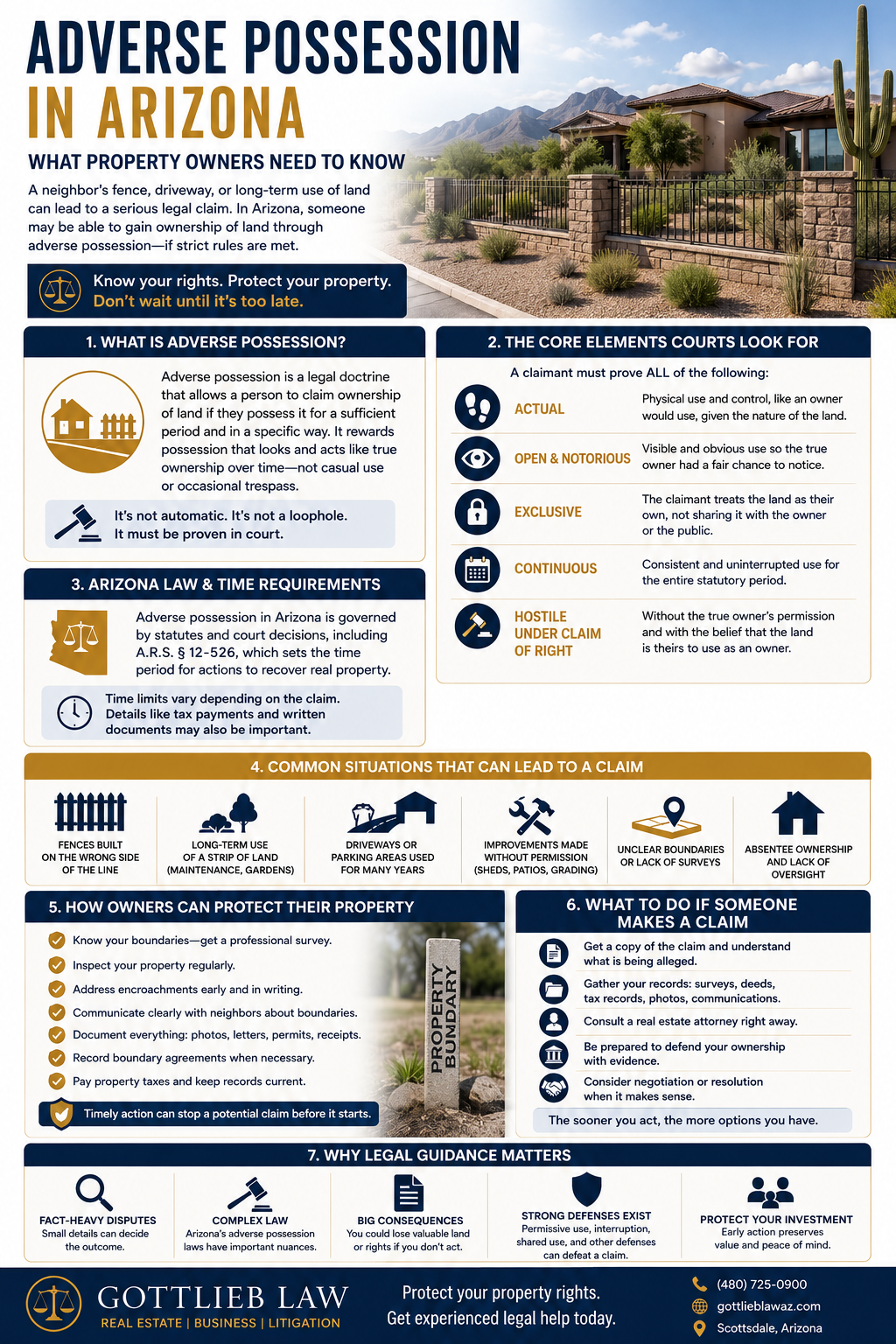
Courts typically look for possession that is actual, open and notorious, exclusive, continuous for the statutory period, and hostile under a claim of right. Those terms sound technical, but the real-world meaning is easier to understand if you picture what ownership looks like day-to-day.
Actual possession generally means physical use and control. It’s not enough to walk across a corner once in a while. The claimant’s use must look like the kind of use an owner would make, given the nature of the land. That could mean fencing, maintaining, building improvements, storing materials, grading, or otherwise treating the area as their own.
Open and notorious means visible. The true owner must have had a fair chance to notice the use. Secret use doesn’t support a claim. If an owner could reasonably look at the property and see what’s happening, this element is more likely to be satisfied.
Exclusive means the claimant is treating the land as their own, not sharing it freely with the true owner or the public in a way that would undermine the claim. Shared use often creates defenses for the owner, especially if the owner can show they also used the area.
Continuous means consistent over the required time period. A claim can collapse if use was intermittent, abandoned, or meaningfully interrupted. The timeline is one of the most contested parts of these cases because people remember history differently, and documents don’t always exist.
Hostile under claim of right is often misunderstood. It doesn’t require personal hostility or conflict. It generally means possession occurred without the true owner’s permission and under the claim that the land is the claimant’s to use as an owner would. Permission is a major issue here, and it’s one reason friendly neighbor arrangements can backfire later.
Here’s the practical takeaway. If the use appears to be ownership, remains consistent for years, is visible, and wasn’t permitted, an owner should take it seriously.
Time Requirements And The Role Of Taxes And Paperwork
People usually ask one question first: “How many years does it take?” Arizona’s rules depend on the situation, and the details can matter more than the headline number. The statutory framework in A.R.S. 12-526 is a key starting point, and real cases require matching the facts to the correct legal theory.
Taxes and paperwork can also matter, depending on how the claim is framed. In some situations, payment of property taxes and the presence of written instruments can become important facts in the dispute. In other situations, the dispute centers more on possession behavior and whether the owner effectively abandoned control of the disputed area.
If you’re trying to protect land, the practical lesson is simple. Documentation and timelines are the oxygen in these disputes. Surveys, dated photos, permits, receipts, maintenance records, and written communications often become more persuasive than memory. If you’re defending against a claim, proving interruptions, shared use, or permission can be just as important as challenging the timeline itself.
Common Adverse Possession Scenarios We See In Arizona
Adverse possession issues often aren’t about someone trying to take an entire parcel. Many disputes involve narrow strips of land that people treat as part of their yard, driveway, or access route for years.
Fence line encroachments are the classic scenario. A fence is installed off the true line, landscaping grows in, sprinklers get installed, and years pass without a survey. The neighbor behind the fence starts thinking of that strip as theirs, and their actions may reinforce that belief.
Driveways and access routes also give rise to claims. A neighbor may use a side driveway, a cut-through, or a turnaround area for years, and the use can start to look permanent. In rural areas, long-term use of paths, gates, grading, and storage can blur boundaries even faster, especially where lines aren’t clearly marked on the ground.
Vacant land creates a different kind of risk. If a property owner doesn’t visit or inspect regularly, a neighbor’s use can grow from minor to substantial without resistance. Over time, that can shift the story from “they borrowed it” to “they treated it as theirs.”
Multi-parcel and investor-owned properties can be vulnerable too. Maintenance crews may mow or maintain over a line without anyone realizing it. Tenants may use areas they don’t legally control. If nobody audits the boundaries, the habits become “the way it’s always been.”
What Counts As Permission And How It Can Defeat A Claim
Permission is often one of the strongest defenses to an adverse possession claim. If the true owner permits the use, the possession is generally not “hostile” in the legal sense, even if the neighbor later acts as if entitled.
This is where casual neighbor relationships can create long-term complications. A homeowner might say, “Sure, use that corner,” or “Go ahead and park there,” and never document it. Years later, the property changes hands, memories fade, and the friendly arrangement turns into a dispute with no paper trail.
Written permission, license agreements, leases, boundary agreements, and even clear text messages can help show that the use was allowed. In addition, evidence of shared use can support the argument that the neighbor wasn’t acting as the exclusive owner.
If you’re an owner and you want to keep things friendly while staying protected, the goal is clarity. Clear boundaries, written permission when appropriate, and regular property checks can prevent a minor accommodation from turning into a title problem.
How Adverse Possession Disputes Usually Surface
These disputes often surface at the worst possible time. A survey happens for a sale. A buyer’s lender requires boundary confirmation. A homeowner pulls permits for an addition. A neighbor replaces a fence, and somebody finally measures.
In escrow, a new survey or inspection can expose an encroachment that’s been ignored for years. Once the issue is visible in documents, it becomes harder to ignore. Title companies may require resolution before insuring. Buyers may demand credits or repairs. Lenders may pause underwriting.
Outside escrow, disputes also surface after neighbor relationships break down. What felt like normal sharing can turn into a hard boundary conflict after a disagreement, a divorce, an inheritance, or a new owner moving in next door.
What Property Owners Should Do If They Suspect An Adverse Possession Issue
If you suspect a boundary issue, your best move is to get organized and get accurate. Guessing can make it worse, especially if you confront a neighbor without facts and accidentally create admissions or inconsistent statements.
Obtaining a survey from a qualified professional is often an important early step. In many cases, it’s the first objective step that cuts through years of assumptions. Then document the current conditions with dated photos and notes. Capture fences, landscaping, improvements, access paths, and anything that shows how the land is being used.
Next, gather your ownership documents. Deeds, prior surveys, title documents, permits, boundary agreements, and communications all matter. If the disputed strip has changed hands or the property has been modified, those records may help reconstruct the timeline.
If a dispute is active, keep communication controlled and factual. Escalating the conflict on social media, arguing in the yard, or sending angry messages can create evidence that hurts your position. A structured legal approach is usually more effective than an emotional back-and-forth.
Here are smart early steps that protect owners and preserve options.
- Order a professional survey, and keep copies of the report and supporting documents.
- Photograph the boundary area and improvements, and record dates for your files.
- Gather deeds, prior surveys, title records, permits, and written communications.
- Avoid informal permission conversations that create confusion or mixed signals.
- Contact counsel early if there is a threatened claim or a transaction deadline.
What Buyers And Sellers Should Know Before Closing
Adverse possession risk is not only a neighbor problem. It’s a transaction risk. Buyers want to know they’re buying what they think they’re buying, and lenders want collateral that matches the legal description.
Buyers should consider surveys and boundary reviews during due diligence, especially for properties with older fences, long driveways, rural acreage, or visible use along the edges. If you see improvements that look like they cross a boundary, don’t assume it’s harmless. Get it evaluated before contingencies expire.
Sellers should avoid last-minute surprises. If you know there’s a boundary issue, address it early. Waiting until the final week of escrow can kill deals, create price concessions, and put you under pressure to settle quickly.
Titles, surveys, and boundary clarity are easier to manage at the front of a transaction than at the end.
How These Claims Get Resolved In The Real World
Many disputes are resolved without a full trial, but resolution still requires clean documentation and proper legal steps. Some cases settle through boundary line agreements, deeds, or negotiated adjustments that clarify ownership and remove future uncertainty. Other cases require quiet title actions or court involvement when parties can’t agree.
The practical goals are usually the same. Clear title. Clear boundaries. No future surprises when the property sells again.
The best resolution path depends on the evidence, the timeline, and the value of the disputed land. A narrow strip may justify a pragmatic settlement. A meaningful portion of land may require aggressive defense or a formal title action.
Get A Clear Strategy Before The Dispute Gets Expensive
If you’re dealing with a boundary dispute, an encroachment, a threatened adverse possession claim, or a transaction impacted by a survey surprise, Gottlieb Law can help you get clarity fast. A focused review of the facts, documents, and timeline can show whether you have strong defenses, whether the issue can be settled cleanly, and what steps protect your ownership rights. Contact us online to schedule a consultation or call us at: 602-899-8188.
Frequently Asked Questions About Adverse Possession in Arizona
What Is Adverse Possession In Arizona?
It’s a legal doctrine where someone may claim ownership of land through long-term possession that meets specific legal requirements. Time alone isn’t enough. The claimant must prove the required elements with evidence.
How Many Years Does Adverse Possession Take In Arizona?
It depends on the facts and the legal theory being applied. People often want a single number, but courts focus on continuous possession and proof. Reviewing the specific facts with qualified legal counsel is the safest approach.
Can Someone Take My Land If I Never Gave Permission?
Lack of permission is often part of the analysis, but the claimant still must prove every required element. Many claims fail because the use wasn’t exclusive, wasn’t continuous, or wasn’t clearly ownership-like. Owners who act early often have stronger defenses.
Does Paying Property Taxes Matter For Adverse Possession?
Taxes and documentation can matter in certain cases, depending on how the claim is framed. Courts look at the full record, not one factor in isolation. A claim can weaken quickly if paperwork and timelines don’t align.
What If A Fence Is On The Wrong Property Line?
A fence alone doesn’t automatically transfer ownership. It can become evidence of long-term possession if other elements are met over time. A survey and dated documentation are usually the first practical steps.
Can Adverse Possession Happen On Vacant Land?
Yes, especially when owners don’t monitor boundaries. The claimant still has to show actual, visible, continuous use that appears to be ownership. Regular inspections and clear boundary markers reduce the risk.
Can A New Owner Stop An Adverse Possession Claim?
Buying the property doesn’t erase past facts, but new owners can take steps to protect their rights going forward. Surveys, notices, and boundary documentation can help prevent continued possession. Fast action matters if you discover an issue after closing.
Can Adverse Possession Claims Be Settled Without Going To Court?
Yes, many disputes are resolved through negotiated agreements, deeds, or boundary line adjustments. Settlement can save time and reduce costs, especially for small boundary areas. Any agreement should be documented properly to prevent future disputes.