

Gottlieb Law, PLC provides this article for information purposes only and nothing herein creates an attorney-client relationship. You should not take any actions in reliance on any of the information contained herein without consulting with qualified legal counsel first and reading this article is not a proper substitute for seeking legal advice of your specific situation. Laws change over time and you should seek counsel to discuss any specific legal questions.
A lis pendens is one of those phrases that can turn a calm real estate transaction into a high-stress scramble. It usually shows up on a title report right before closing, during a refinance, or while an investor is trying to move quickly on a purchase. In plain English, it’s a recorded notice that tells the public there’s a lawsuit involving a claim that may affect the property’s title or the right to possess it.
That doesn’t mean the person who recorded it is right. It doesn’t mean the owner did anything wrong. It doesn’t mean the court has ruled on anything yet. Still, it can cause very real problems because real estate relies on a clear title and predictable risk. Once a lis pendens is recorded, buyers hesitate, lenders become cautious, and title companies typically flag it as a significant issue, and many transactions require it to be resolved before closing.
This is general information, not legal advice. If you’re dealing with an active escrow, a rate lock, or a time-sensitive purchase, getting the recorded notice and the underlying lawsuit reviewed quickly by qualified legal counsel is often the fastest way to get control of the situation.
What A Lis Pendens Is And What It Is Not
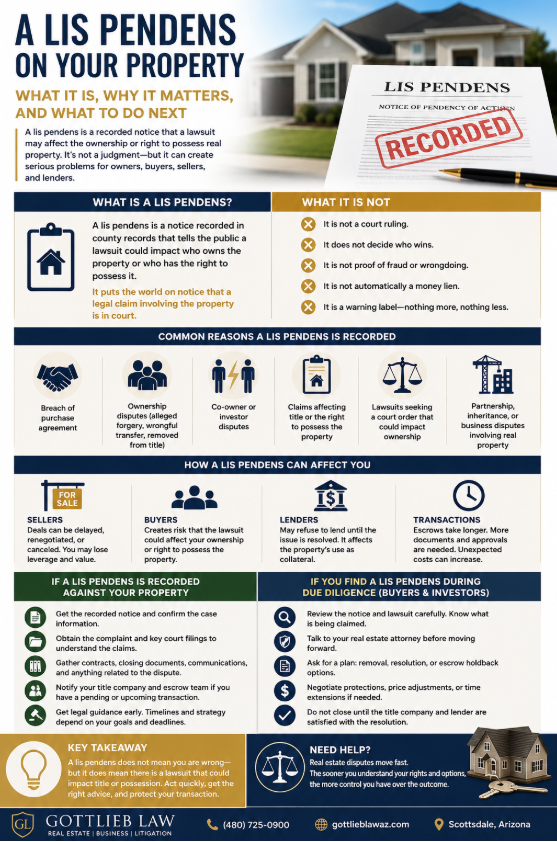
A lis pendens is a notice recorded in county records that’s connected to a lawsuit involving the property. Its job is to put the public on notice that the lawsuit could impact who owns the property or who has the right to possess it. Because it’s recorded, it tends to appear on title reports and becomes part of the public record tied to the parcel.
It’s not a judgment. It’s not proof of fraud. It’s not a final determination of ownership. Think of it as a warning label that tells the market there’s an unresolved legal claim that might change property rights.
It also isn’t the same thing as a money lien. People mix these up because both can disrupt a transaction, but they’re different tools with different purposes. A lis pendens is tied to litigation over a property interest, not simply an unpaid bill.
In Arizona, a lis pendens generally must be tied to a lawsuit that actually seeks to affect title, ownership, or possession of the property—not simply a dispute over money.
- It’s a recorded notice tied to a lawsuit involving a property claim.
- It isn’t a court ruling, and it doesn’t decide who wins.
- It isn’t automatically a money lien, even if it clouds title in practice.
Common Reasons A Lis Pendens Gets Recorded
Most lis pendens situations arise from disputes where someone claims a right connected to the property itself. A common example is a broken purchase agreement in which one party claims the right to enforce the contract and complete the sale. Another example is an ownership dispute, including contested transfers, alleged forged documents, or claims that someone was wrongfully removed from title.
Business and co-owner disputes also show up often. Investors fall out. Family members disagree after an inheritance. Co-owners disagree on whether to sell. If the lawsuit asks the court to decide ownership or possession rights, or to order a transfer that affects title, a notice may appear.
Not every real estate disagreement supports recording a lis pendens. That’s where things can get messy, especially when one side uses the notice as leverage to pressure the other side during negotiations.
How A Lis Pendens Can Affect Selling, Buying, And Financing
The practical impact is usually fast and obvious. Once the notice shows up, many buyers slow down or pause. Title companies flag it because it raises questions about a marketable title. Lenders can treat it as a major underwriting problem because the property is the collateral for the loan, and they want that collateral clean.
For sellers, this can mean the deal gets delayed, renegotiated, or lost entirely. Even if you believe the lawsuit is weak, the buyer may not want to bet their down payment and future ownership on your confidence. For buyers, it creates a risk that the lawsuit could later affect their ownership or right to possess the property. For refinances and home equity loans, lenders may refuse to fund until the issue is cleared.
Here’s what often happens in real transactions.
- Escrow timelines stretch because everyone needs more documents and answers.
- Buyers ask for price changes, additional protections, or removal before closing.
- Lenders and title insurers may pause until the title risk is addressed.
- Sellers can lose leverage if they’re under time pressure to close.
What Property Owners Should Do If A Lis Pendens Is Recorded Against Their Property
If you’re the owner, the biggest mistake is treating this as a public relations issue rather than a legal or title issue. What matters is the recorded document and what the lawsuit actually claims. Your first move should be to obtain a copy of the recorded notice and confirm the recording details. Next, obtain the complaint in the lawsuit and review the specific property interest being claimed.
If you’re in escrow or preparing to refinance, notify your title company and escrow team so they aren’t learning about it through surprise updates. At the same time, keep your communications factual. Over-explaining or guessing can create confusion that hurts negotiations.
From there, strategy depends on the facts. Some situations call for challenging the notice, especially if the lawsuit doesn’t support it. Other situations call for negotiating a resolution that results in a release being recorded. Timing matters, and your approach should reflect whether you’re trying to protect a current transaction, reduce ongoing damage, or position the case for a faster end.
- Get the recorded notice and confirm the case information tied to it.
- Pull the complaint and key filings so you know what’s actually being alleged.
- Gather contracts, closing documents, and relevant communications in one place.
- Get legal guidance early if there’s a closing date or financing deadline involved.
What Buyers And Investors Should Do If They Find One During Due Diligence
Buyers should treat a lis pendens as a serious due diligence checkpoint. Start with documentation. Ask for the recorded notice and the lawsuit complaint. Confirm what rights are being claimed and what the plaintiff wants the court to do. A lawsuit seeking to change ownership rights has a different risk profile than a dispute that’s mostly financial.
Next, talk to your lender and title company early. Even if you’re personally comfortable proceeding, the lender may not fund the loan, and the title insurer may not offer the coverage you expect. That reality often decides the deal.
From a deal-making standpoint, buyers usually have three options. Require removal before closing, renegotiate with real protections in writing, or walk away if the risk doesn’t match the upside. The wrong move is acting like the notice is harmless without understanding the lawsuit.
- Request the notice and complaint, and confirm the claim involves the property interest.
- Ask your lender and title company what they require to proceed.
- Keep contingencies in place until the risk is addressed in writing.
Wrongful Or Improper Notices And What That Can Mean
Lis pendens filings can be misused as leverage, especially in disputes that feel personal or high-stakes. If a lawsuit doesn’t truly support a recorded notice against the property, the recording may be challenged. Courts can address improper filings, and there can be consequences in certain circumstances.
Still, outcomes depend on details. The key point is simple. Don’t assume it’s valid just because it’s recorded, and don’t assume it’s invalid just because it feels unfair. Treat it as a document-and-facts problem that needs a direct legal evaluation.
How These Disputes Usually Get Resolved
Most lis pendens situations end in one of a few ways. The lawsuit settles, and the parties record a release. The court dismisses the underlying claim, thereby clearing the notice. The court issues orders that directly address the notice. In some cases, litigation runs to a judgment that clarifies ownership or possession rights.
From a practical viewpoint, resolution is often driven by timing. If a transaction is pending, the pressure to resolve increases. If no transaction is pending, parties may move more slowly. Either way, a clear plan is better than drifting, while the notice continues to disrupt the property’s marketability.
Talk to an Experienced Arizona Real Estate Lawyer
If you’re dealing with a recorded lis pendens, a threatened filing, or a stalled transaction tied to a property dispute, Gottlieb Law can help you get clarity quickly. A focused review of the recorded notice and the underlying lawsuit can reveal whether you’re looking at a manageable issue, a serious title risk, or a filing that should be challenged. Contact us online to schedule a consultation or call us at: 602-899-8188.
Frequently Asked Questions About Lis Pendens In Arizona
What Does A Lis Pendens Mean?
It’s a recorded notice that a lawsuit may affect the property’s title or possession rights. It doesn’t prove anyone is right. It signals risk that can disrupt a transaction.
Can I Sell A House With A Lis Pendens?
Sometimes, but it often delays or stops sales. Many buyers and lenders won’t proceed until it’s cleared. Many transactions require the issue to be resolved before closing.
How Long Does A Lis Pendens Last?
Usually, until the lawsuit is resolved or a release is recorded. Timelines vary depending on the case and court schedule. If you’re in escrow, delays can add real costs.
Does A Lis Pendens Mean I Lost The Case?
No. It isn’t a judgment or a ruling. It only means litigation is pending that may affect property rights. The court still has to decide the merits.
Can It Stop A Refinance?
Yes, it can. Lenders often pause or deny funding due to title risk. Clearing the issue is commonly required to proceed.
Is It The Same As A Lien?
Not exactly. A lis pendens is a notice of litigation tied to a property claim. Many liens are tied to debts, though both can cloud title and slow deals.
What Should Buyers Do After Finding One?
Get the recorded notice and lawsuit complaint. Ask your lender and title company what they require. Don’t waive contingencies until the risk is addressed.
Gottlieb Law, PLC provides this article for information purposes only and nothing herein creates an attorney-client relationship. You should not take any actions in reliance on any of the information contained herein without consulting with qualified legal counsel first and reading this article is not a proper substitute for seeking legal advice of your specific situation. Laws change over time and you should seek counsel to discuss any specific legal questions.